
Recent research claims that AI agents taking surveys pose an "existential" and "fundamental" threat to online survey research. Those who depend on survey and market research have expressed great concern.
Verasight’s reaction was more sanguine. We explained how Verasight’s long term strategies to ensure attentive and representative human samples also worked to prevent AI fraud (see, here and here).
Two independently conducted research studies examined Verasight data and validate our approach. The most recent study was funded by the survey firm, Prolific, and includes research by seven prominent experts. The study recruited 5,200 respondents across 10 survey platforms. They utilized an automated environment check, which monitors numerous factors known to indicate AI agents, such as automated scripts, AI-driven browser tools, navigation patterns, and session meta data, plus six behavioral tests, such as mouse movement and Research Defender risk score, to identify AI agents in actual surveys. Across both measures, there was near zero evidence of AI agents in Verasight surveys.
A second recent study found equivalent results. Dartmouth Professor, Brendan Nyhan (who was not part of the study) concluded, "The sky is not falling."
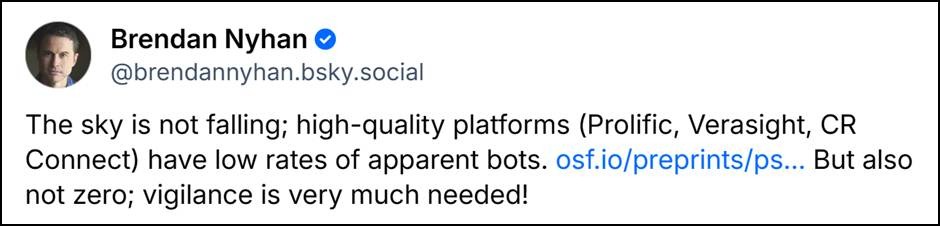
The main lesson from these independent studies is that the threat of AI agents taking surveys is limited to three approaches: survey marketplaces, survey firms that rely extensively on these marketplaces, and general task marketplaces, such as Amazon MTurk. In the Prolific-funded study, AI-agent detections were concentrated almost exclusively on Amazon MTurk, at 11 to 16 percent of responses, while every other platform came in at or below 1 percent.
Firms like Verasight, that never outsource data collection, limit how many surveys respondents can take, verify respondents when they enter the panel, and regularly monitor environmental and behavioral response data, continue to offer high quality and representative survey data.
Importantly, the verification of human respondents is a necessary, but certainly not sufficient, indicator of survey data quality. In order to understand the American public, it’s important that a survey sample is representative on observed demographics. For Verasight’s nationally-representative surveys, these include gender, age, education, race/ethnicity, income, Census region, metropolitan status, party identification, and 2024 vote. It’s also important to understand how many surveys respondents have taken in order to mitigate respondent fatigue. Verasight, for instance, throttles the number of surveys a respondent can take at any given time.
For more on Verasight’s demonstrated data accuracy, see our 2025 state and NYC election polling results.