A new Verasight survey finds that nearly two-thirds of Americans say they now use AI tools at least monthly — a rate of adoption faster than previous consumer technology released in the last century. While adoption has been fast, anxiety about the technology persists; many Americans do not know if they can trust AI outputs, and are worried about consequences to human creativity and employment.
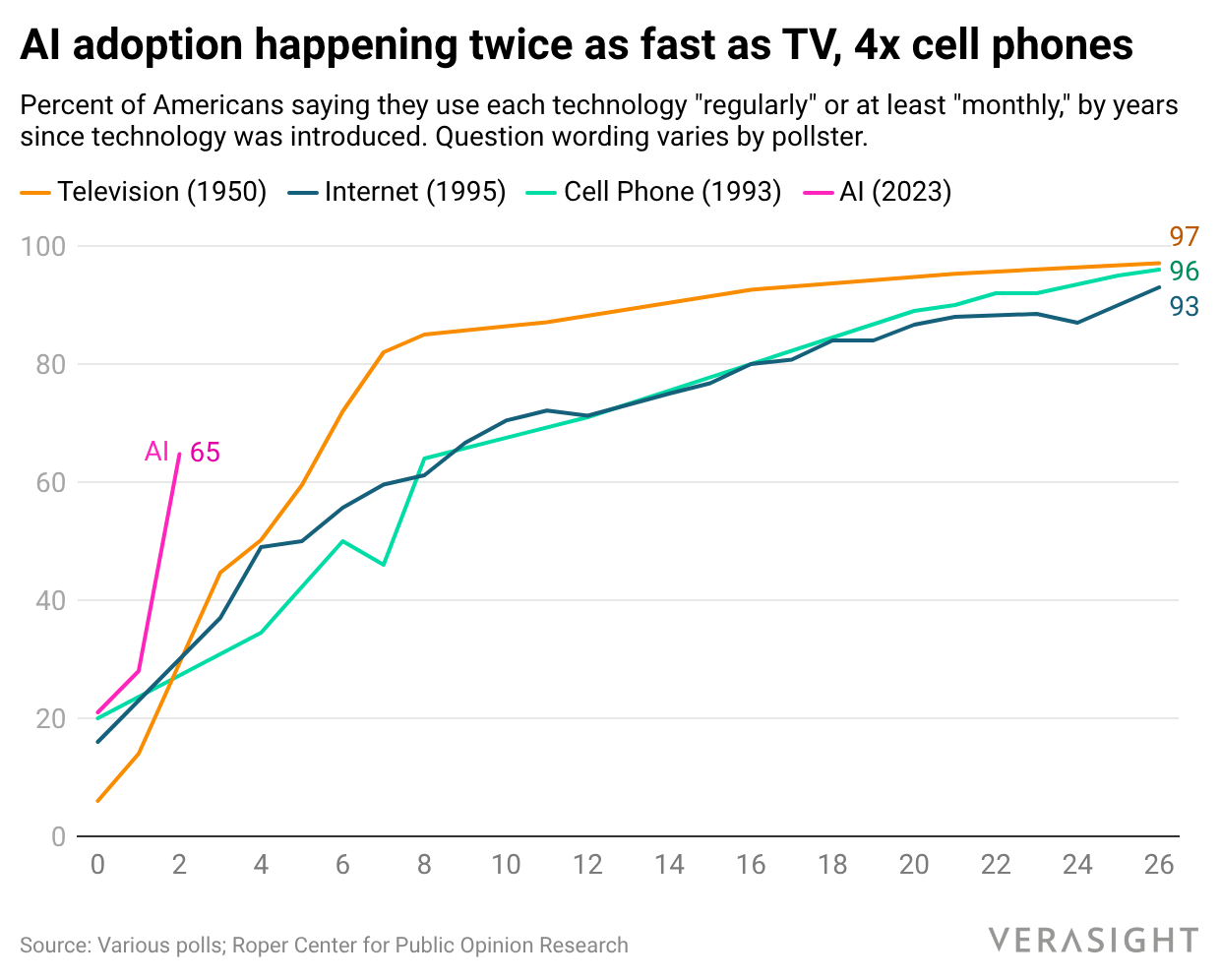
According to a Verasight survey fielded from Dec. 22, 2025 to Jan. 6, 2026, 64% of American adults used AI tools in their work or personal lives at least once in the past month. As the chart below shows, that pace of adoption is about twice as fast as television in the 1950s and roughly four times faster than cell phones in the 1990s, the steepest adoption curve for any major consumer technology on record.
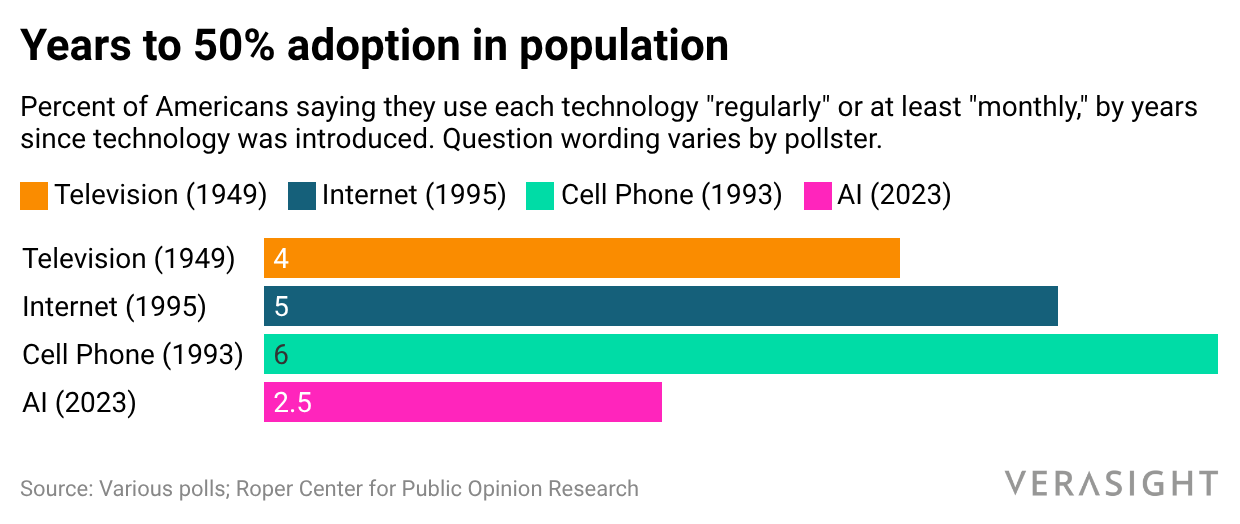
Averaging across results of other surveys, including tracking from Gallup, 65% of Americans report using AI at least monthly in late 2025/early 2026. In comparison, 65% of Americans did not own a television until late 1950, six years after the technology was introduced to the masses. And according to an archive of surveys from the Roper Center for Public Opinion Research, AI has gained as many users in two years as cell phones did in eight.
This speed of adoption is matched by the depth of engagement. Half of all Americans (50%) now say they use AI at least once a week, and more than one in four (26%) say they use it daily. The most common touchpoint for the new technology is the AI chatbot: 60% of respondents said they had asked a question to a service like ChatGPT, Google Gemini, or Microsoft Copilot in the past month. For context, that is nearly double the share who said they had read a newspaper (35%) over the same period. Moreover, awareness of the leading chatbot companies is high: 88% have heard of OpenAI's ChatGPT, 80% of Google's Gemini, and 62% of Microsoft's Copilot.
The most common use case for AI today is as a replacement for search. Beyond that, 45% of users said they use it to write or edit personal messages, emails, or social media posts; 39% turn to it for recommendations; and 32% use it for personal organization or health and fitness advice. Among current users, 21% say they have already replaced at least one task they used to do themselves.
Yet despite rapid adoption, a significant minority of Americans remain hesitant of or opposed to the technology. Twenty-two percent of adults say they never use AI tools, and another 15% use them less than once a month. When non-users are asked why, the most common reason, cited by 48% of adults, is that they haven’t found a use for the technology. The second most common answer is distrust: 37% don’t use AI because they don’t trust it. Concerns about societal impact (29%), privacy (26%), and not knowing how to use the tools (17%) round out the main barriers. Cost is almost never the issue; only 3% cited expense. The barriers to broader adoption are psychological and practical, not economic.
The emotional landscape is complex. While adoption is high, enthusiasm is not. Fifty-six percent of Americans say they feel at least somewhat anxious about the rise of AI, including 22% who strongly agree with the statement. Only 42% say they are excited about AI’s possibilities. Notably, younger Americans, the cohort most likely to use AI, express the greatest anxiety: 28% of adults aged 18–29 strongly agree that AI’s rise makes them anxious, more than any other age group. Trust in the companies building these tools is low: only 25% agree that tech companies will develop AI responsibly, while 50% somewhat or strongly disagree.
The specific concerns driving this anxiety center on practical near-term risks. Loss of human oversight in AI use worries 63% of Americans (extremely or very concerned), followed closely by the loss of human creativity and interaction (62%), the potential for cyberattacks (61%), and AI-generated misinformation (61%). Fear of AI dominating humans ranks lower at 43%, behind job displacement (54%) and bias in AI training data (55%).
In all the technological revolutions in U.S. history, there have been holdouts. In the 1950s and 1960s, many families refused to install televisions for fear of ruining their children's critical thinking skills. And smartphones were decried as expensive, unnecessary distractions. AI has its holdouts, too. Yet the pace of adoption points to the relatively obvious utility of the products to the average American, especially the student, busy CEO, modern knowledge worker, and so on.
For more information, read Verasight's recently released 2026 Predictions Report: AI Adoption in 2026 and access the complete data here.