
.png)



















.png)
Executive Summary
A new poll from Verasight reveals a paradox for Americans’ use of technology in 2026: nearly two-thirds of the country has adopted artificial intelligence into their daily routines, yet a majority are anxious about the technology’s implications for employment, relationships, and society more generally.
2025 was the year AI use became commonplace for the average American. The majority of every generation now reports using AI in their work or personal lives over the last month. More Americans say they have used an AI chatbot (60%) over the past month than have read a newspaper (30%).
While many users are enthusiastic about the possibilities of AI, most are still not blind to its risks. Fifty-six percent of respondents to our survey report at least some anxiety about AI’s rise, and only 42 percent express excitement about its possibilities. Thirty-seven percent of non-users cite distrust as their reason for avoiding AI, and 29 percent worry about AI’s broader societal impact.
For policymakers and technology leaders, the challenge of AI is no longer adoption, but trust. Until companies and institutions building AI systems can address fundamental concerns about trustworthiness, privacy, and social responsibility, Americans will remain trapped between enthusiasm and anxiety, using AI while quietly wondering if they should. In 2026, businesses may yet profit despite this uncertainty — but equally, so will thought leaders who speak for the uncertain.
Click here to access the full toplines and crosstabs for this survey.
AI penetration in everyday life
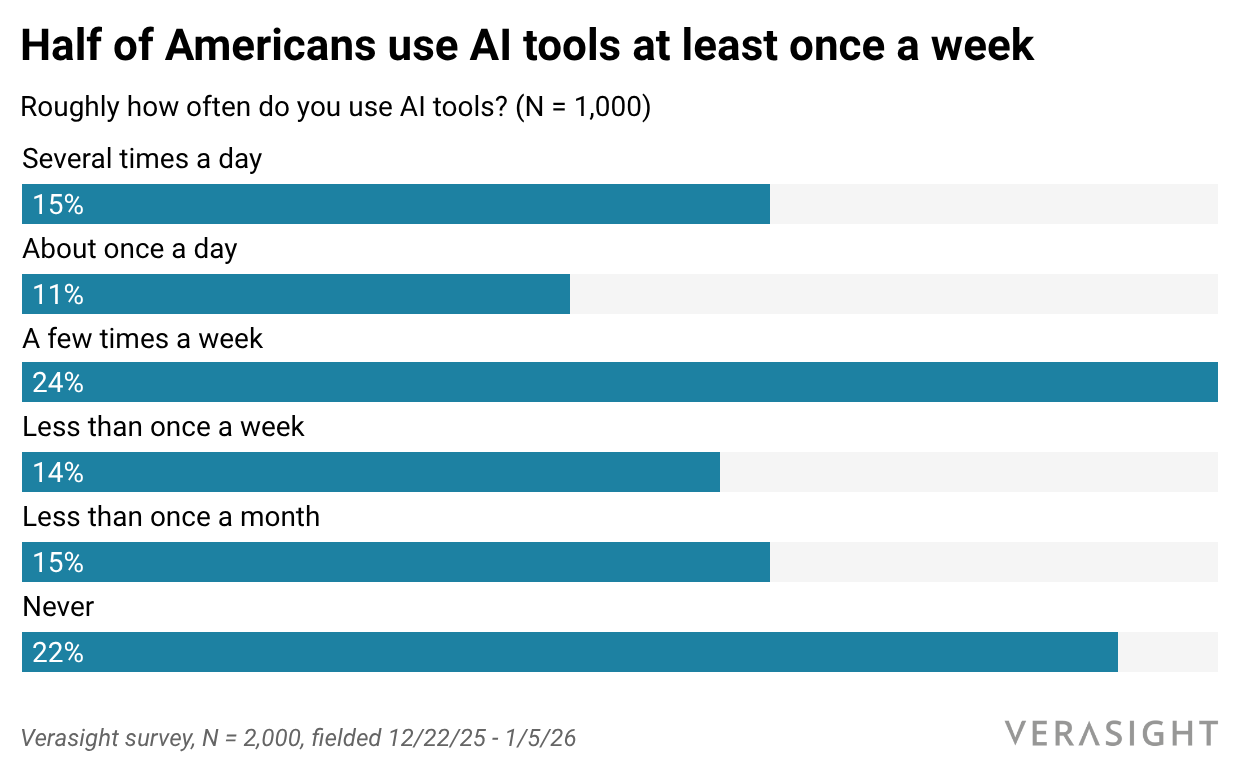
Our survey finds that 64 percent of Americans report using artificial intelligence tools in their work or personal life at least once over the past month. The rate of AI adoption among Americans has been about twice as fast as that for smartphones in the last 2000s. Additionally, 50% of Americans report using AI tools at least once a week, with over one-fourth (26%) of adults saying they use them at least once a day.
But what are they using these tools for? The most common use is as a question-and-answer machine; people are replacing Google searches with AI sessions. Sixty percent of respondents said they asked a chatbot like ChatGPT, Google Gemini, or Microsoft Copilot for help over the past month. (For comparison, 87% said they used a search engine). And when it comes to chatbots, those companies account for the vast majority of use: OpenAI’s ChatGPT service leads awareness at 88% in our poll; Google’s Gemini is in a close second, at 80%; and Copilot comes in a distant third place at 62%. No other major AI service surpassed 40% (xAI’s Grok hit 39%).
While all Americans were about equally likely to know of a Big 3 model regardless of age, the lesser-known models are also popular with young people. Over half (51%) of young people said they knew what Grok was, compared to just 35% among seniors. And almost 4-in-10 under-30s knew what Claude AI (the model created by Anthropic) was, compared to just 15% of adults ages 65 and over.
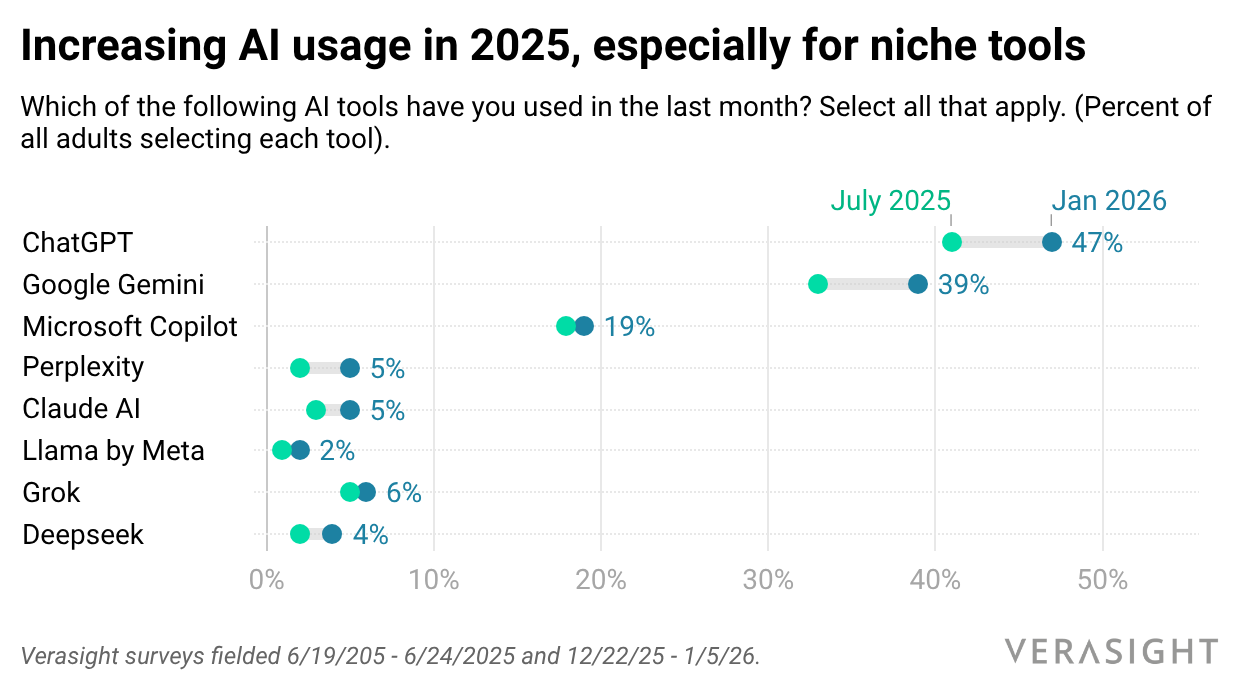
The most-used AI tools are ChatGPT (47%) and Gemini (39%), both of which have significantly increased uptake throughout 2025. About half of all adults now report using ChatGPT at least once per month. In a distant third place, about 19% of people report using Microsoft Copilot (now pre-programmed with every Microsoft Office product). Perplexity, a tool for doing research, Grok, a general-purpose chatbot from billionaire Elon Musk, and Claude (which offers the most popular terminal interface for writing computer code) are all tied for fourth place for usage at around 5%.
As we found in our previous AI reports, the most common use case for AI tools out of the workplace is to replace text-oriented tasks, like communicating with friends and family: 45% of respondents said they use AI to write or edit personal messages, emails, or social media posts. Shortly behind that is getting recommendations for movies, restaurants, or gifts (39%). And tied for third is personal organization and health and fitness advice (32% each). Among respondents who said they used AI in the last month, 21% say they have replaced a task they used to do themselves with AI.
Why some people don’t use AI
On the other end of the spectrum, fifteen percent of AI users say they use such tools less than once a month, and twenty-two percent of the entire adult population reports never using AI tools. More than one in five Americans has no engagement with artificial intelligence, despite its ubiquity.
When we asked these people why they don’t use AI, the most common response was straightforward: forty-eight percent said they had not yet found a use for these tools. But other non-adoption poses more trouble for companies developing these tools. For instance, 37% of non-users said they do not use AI products because they do not trust them. In addition, 29% cite concerns about AI’s broader impact on society, and 26% expressed concerns specifically about privacy. Finally, 17% of adults said they are worried about impacts to the environment, and another 17% said they did not know how to use AI tools. Three percent of users said AI was too expensive (most tools now have a free tier for limited usage).
These data suggest that AI adoption will continue as tools get easier to use, and companies combat fears about privacy and impacts to society. The biggest barriers to AI adoption in America are not economic; they’re practical and psychological. Most Americans who don’t use AI shirk these tools because they don’t see a clear need or don’t trust the output. Those are fixable problems.
Anxiety and hope for an artificial future
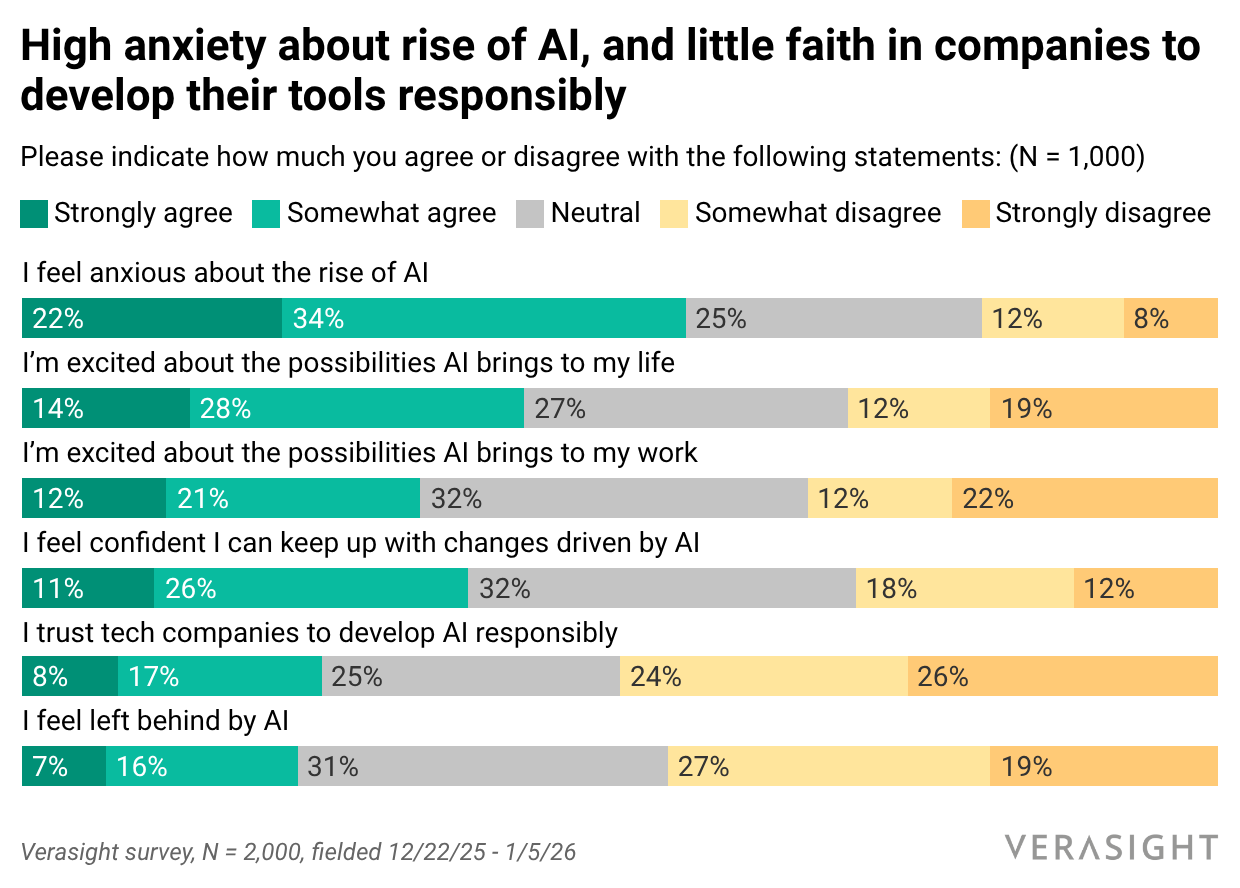
When we asked Americans to give us their emotional response to the rise of artificial intelligence tools, 56% of Americans — nearly half — expressed at least some level of anxiety. Twenty-two percent of respondents said they “strongly agree” with the statement “I feel anxious about the rise of AI,” and another 34% said they “somewhat” agree. Twenty percent, in contrast, somewhat or strongly disagreed with the statement (these people do not feel anxious about AI).
Somewhat surprisingly, younger Americans (those ages eighteen to twenty-nine), the generation growing up with AI, show the most acute anxiety about its societal impacts. Twenty-eight percent of young adults said they were strongly anxious about artificial intelligence, the highest for any group. Youth is usually associated with technological optimism and openness to new tools, but on AI, the youngest Americans are its most worried cohort.
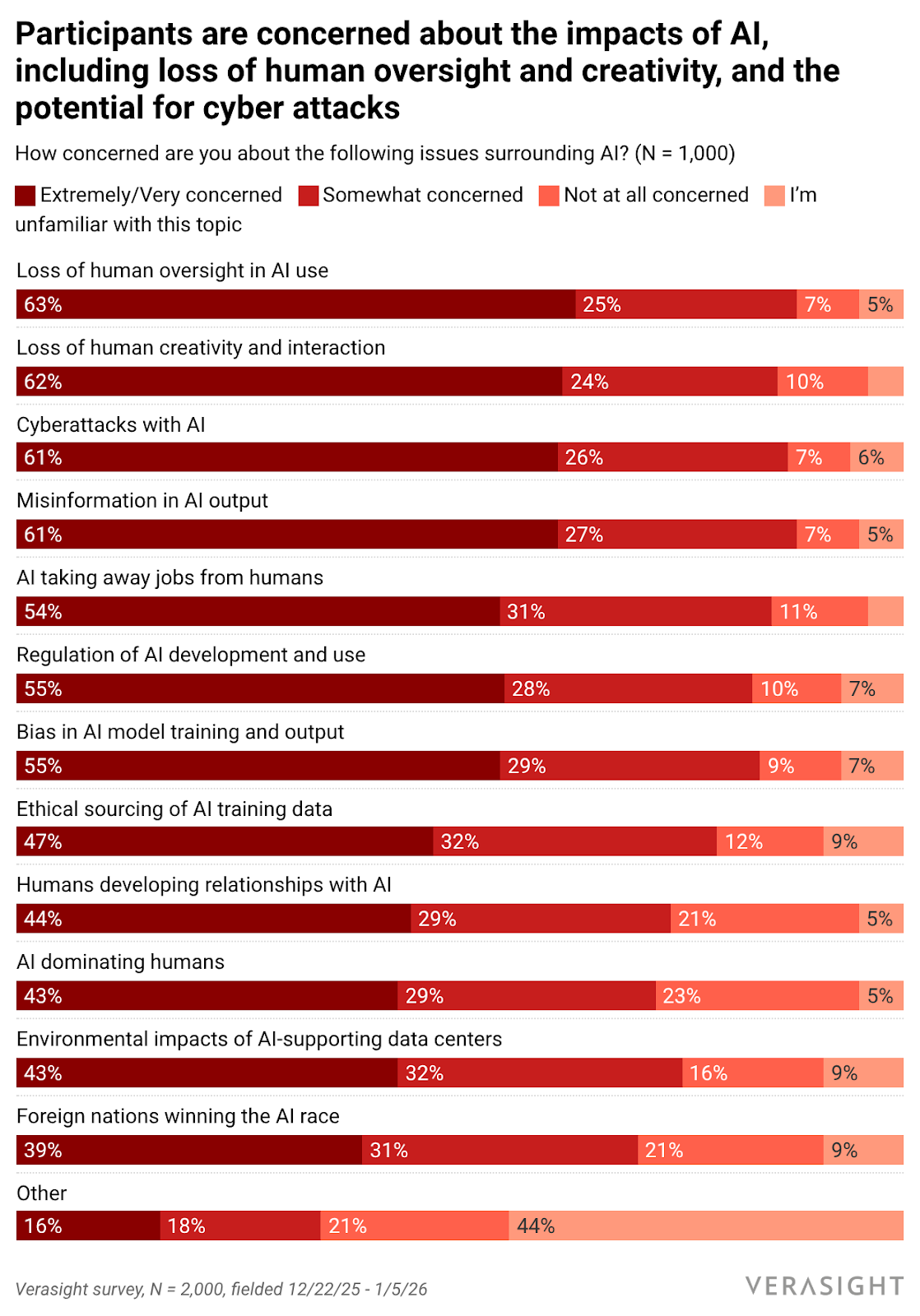
In addition to this anxiety, many Americans express concerns about how AI could shape society and humanity. The top concerns center on control and authenticity: sixty-three percent of Americans say they are extremely or very concerned about the loss of human oversight in AI use, while sixty-two percent worry about the loss of human creativity and interaction. Cyberattacks and misinformation in AI output follow closely, each registering concern from sixty-one percent of respondents. About half are concerned about job displacement. Notably, concerns about AI regulation and bias in AI training rank higher than fears about AI dominating humans or environmental impacts from data centers, suggesting that Americans are more focused on near-term, practical risks than science-fiction scenarios.
Yet there is also hope. When asked whether they are excited about the possibilities AI brings to their lives, 42% of adults said they somewhat (28%) or strongly (14%) agreed. And 33% total reported being excited about how AI could change their work. Young people were more excited than respondents from either the Gen X or Baby Boomer generations.
In addition, 68% of adults predicted AI would decrease the number of jobs in America, while 15% predicted an increase, and 17% said AI wouldn’t have much of an impact on the workforce.
AI as a therapist
Finally, one of the more recent applications of AI is in mental health support. Nearly a quarter of Americans (23%) say they have used an AI tool for mental health or emotional support at some point, with twelve percent using one in the past month alone.
Among adults eighteen to twenty-nine, thirty-four percent have tried AI for emotional support. For those aged thirty to forty-nine, it’s twenty-nine percent. But adoption falls sharply among older Americans: just twenty percent of those ages fifty to sixty-four have tried it, and only eight percent of seniors sixty-five and older. Young Americans are more comfortable talking about their thoughts and feelings with AI.
But what exactly are people doing with AI tools when they use them for emotional support? The most common use is managing stress, anxiety, or sleep issues (fourteen percent of all adults). Twelve percent have used AI for coping strategies like reframing techniques or breathing prompts, and another twelve percent have had what they describe as “therapy-like” conversations with an AI. Relationship and family advice is close behind at 11%. And even crisis information and safety resources show up at 6%.
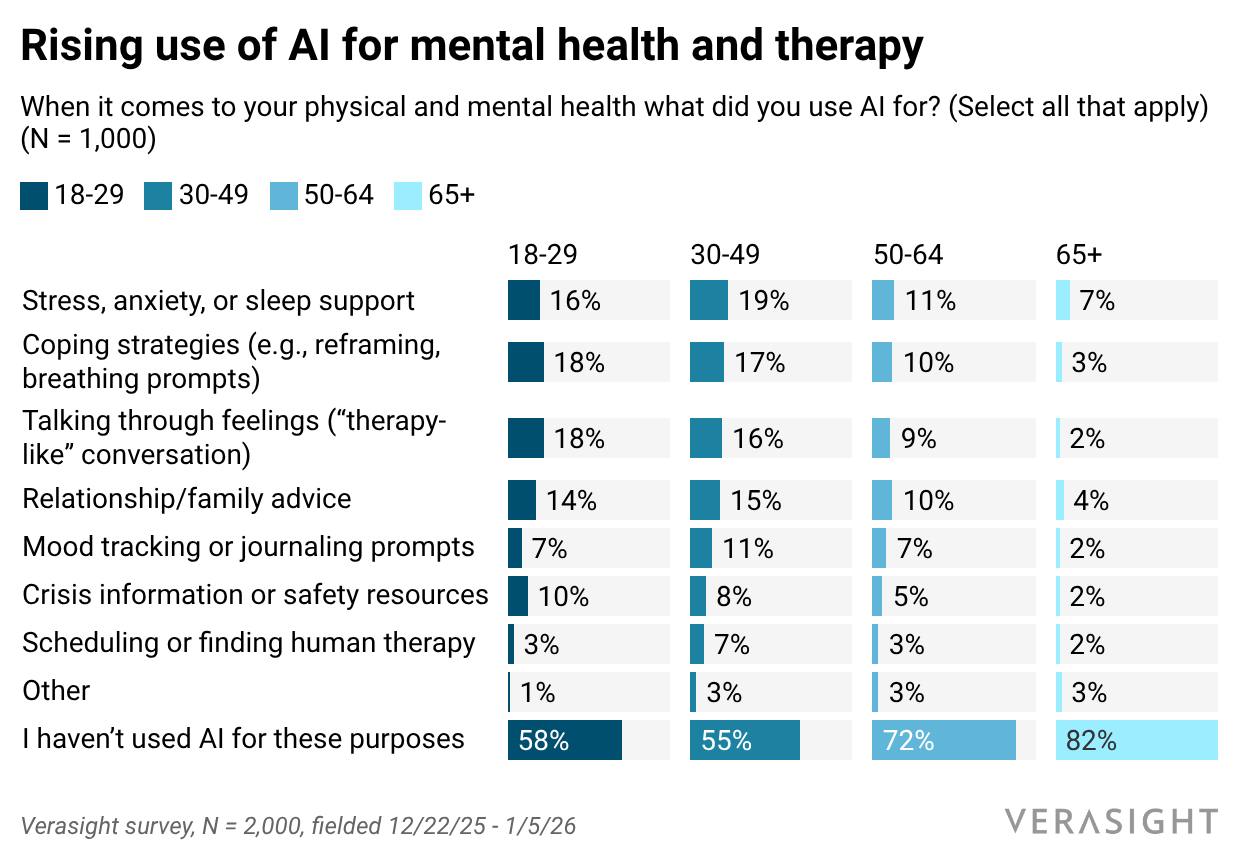
Showing how deeply some Americans trust these tools with their innermost thoughts, 28% of young adults said they would be more likely to bring an emotional problem to an AI chatbot than another human. And some Americans have even developed a reliance on their chatbot friends: 13% responded that they would be “very upset” or “devastated” if their primary AI assistant that they use for mental health were permanently shut down tomorrow.
Conclusion
In addition to this anxiety, many Americans express concerns how AI could shape society and humanity. In 2026, artificial intelligence is no longer new. AI-powered tools for work are embedded in daily applications, and even in our personal lives, usage is rising even as unease about its social, economic, and emotional consequences persists. And newer use cases are emerging too, such as the widespread use of artificial intelligence for emotional support and personal therapy.
There are still some barriers to adoption: namely, practicality. While most knowledge workers in America have no doubt found some use, be it summarizing emails from their boss or generating technical reports, some people just don’t do the type of work AI tools have become so good at. Privacy is also a concern for many. But as 2025 was a year of advances and surprises in the AI space, 2026 may yet bring more use cases and more guardrails that convert the decreasing group of holdouts.