

AI company executives have said publicly that the industry should slow how fast it develops artificial intelligence. Verasight asked Americans whether they agree, and who they think should be responsible. We found broad, bipartisan support for slowing down, and a clear preference for the companies rather than the government to apply the brakes. The survey also found widespread local opposition to data center development, with some willingness to change positions if developers invest directly in local communities.
Opposition to a nearby data center reverses when the money reaches households
Data centers, the buildings that house the computing power behind AI, are not an abstraction for much of the country. 30% say a large data center is already operating or planned within about 10 miles of their home, 10% already operating and 20% planned or proposed.
Asked whether they would favor or oppose one being built that close, 78% oppose, including 53% who strongly oppose. Opposition is bipartisan, at 88% among Democrats and 67% among Republicans.
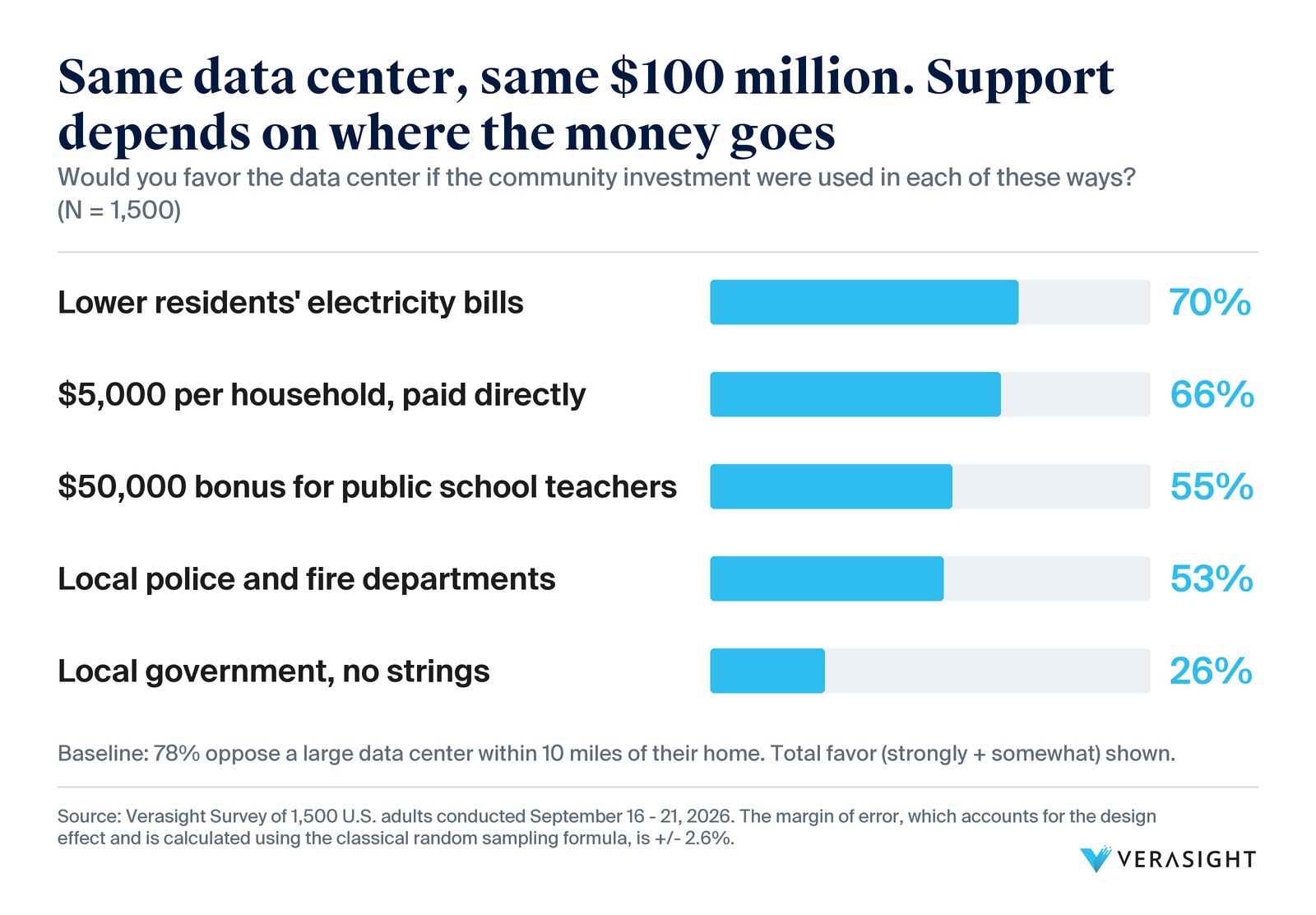
Verasight then asked about the same data center paired with a $100 million community investment over ten years, with every respondent rating five uses of the same money. Support depends almost entirely on where the money lands. 70% favor the data center if the money is used to lower residents' electricity bills and 66% if it is paid directly to residents, about $5,000 per household. Support falls to 55% for a $50,000 bonus for all public school teachers, 53% for local police and fire departments, and 26% if the money is paid to local government to use however it wishes. The same dollar amount moves support by 44 points depending on its use.
The survey also found a tension in how Americans think about their neighbors' property. A majority, 55%, say they would sell their own property to a data center company offered double what it is worth. A separate majority, 54%, say the local community should be able to block a neighbor's sale if most people object. Republicans are the exception on the second question, with 57% saying it is entirely the neighbor's decision.
Nearly two-thirds of Americans want AI development to slow down
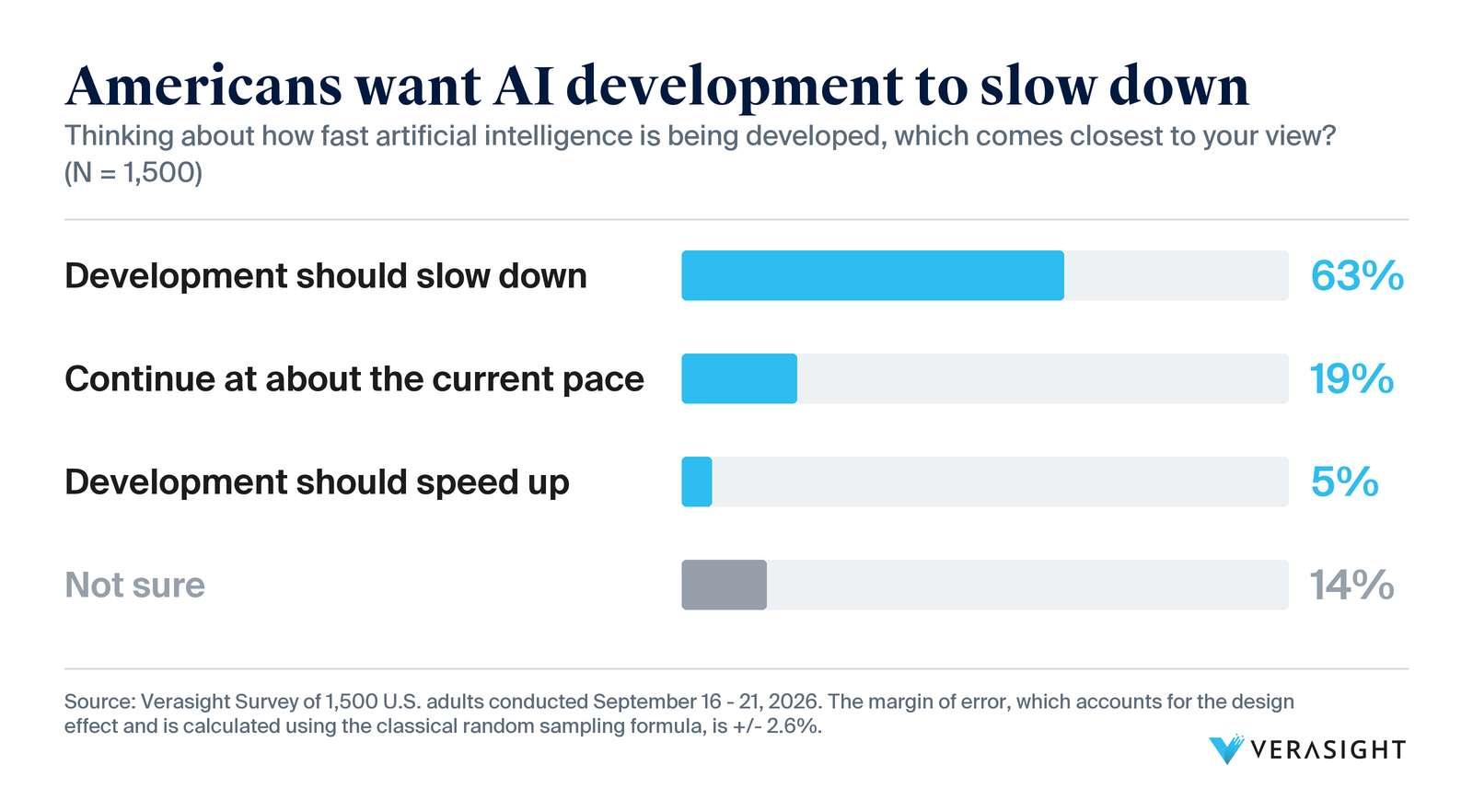
Asked how fast artificial intelligence should be developed, 63% say development should slow down, 19% say it should continue at about the current pace and just 5% say it should speed up. The preference for slowing down is bipartisan: 75% of Democrats, 59% of independents and 51% of Republicans.
Presented with two AI companies offering similar tools, one that develops new features quickly and one that develops more slowly and spends more time on safety testing so its tools are somewhat less advanced, 73% choose the slower company and 12% choose the faster one. Most Americans are unlikely to utilize the capabilities of the most advanced models.
Concerns about AI safety outweigh fears of losing ground to China. A plurality, 45%, say they worry more that AI could be developed too quickly and cause serious harm, against 11% who worry more that the United States could fall behind China. Another 36% say both worry them equally.
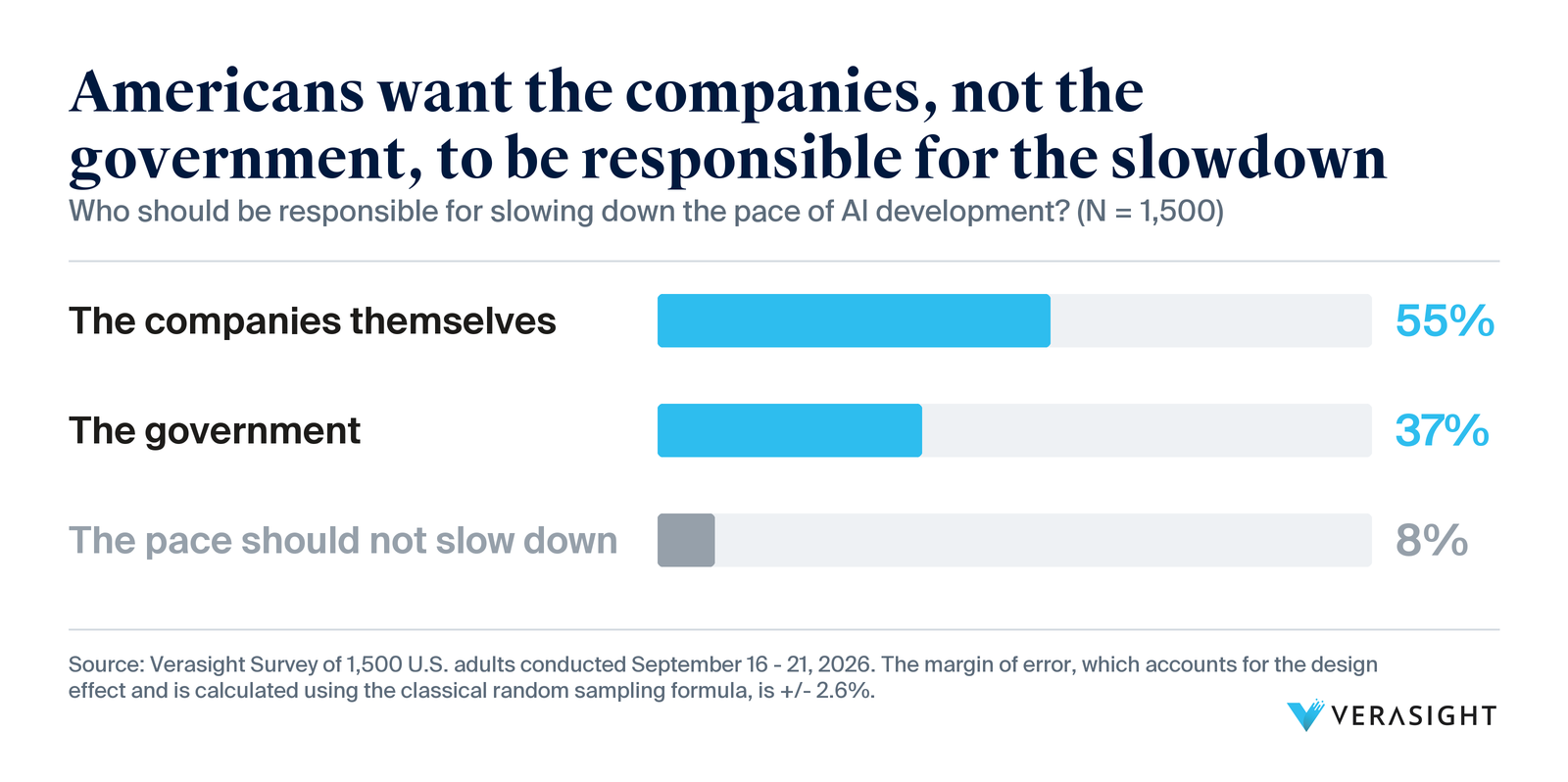
55% say the AI companies themselves should be responsible for slowing the pace, against 37% who say the government and 8% who say the pace should not slow at all. Democrats are the most willing to assign the job to government at 46%, versus 34% of independents and 27% of Republicans, but in no group does government become the majority answer for who should be responsible.
What it adds up to
Across both topics, the pattern is consistent: Americans are not opposed to the technology, but they are cautious about the terms on which it arrives and they expect the companies building it to bear the cost. The full report is available here and you can contact us to learn more about how Verasight helps academic, media, and F500 researchers understand American public opinion.
Source: Verasight Survey of 1,500 U.S. adults conducted September 16 - 21, 2026. The margin of error, which accounts for the design effect and is calculated using the classical random sampling formula, is +/- 2.6%.