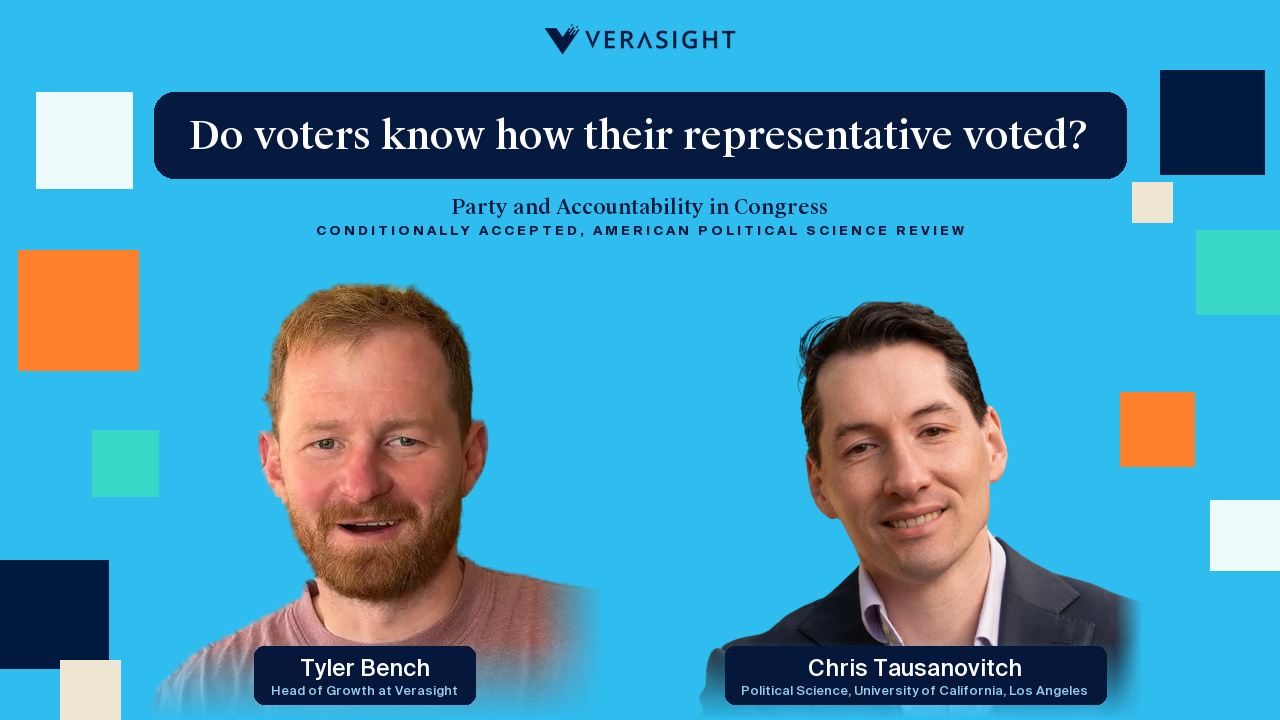
Chris Tausanovitch, Professor of Political Science at UCLA, joined Verasight to talk about "Party and Accountability in Congress," his paper with John Murphy, a PhD student in political science at UCLA. The paper is conditionally accepted at the American Political Science Review, and one of its two original surveys was fielded by Verasight. In this article, we highlight the key points from the interview and discuss next steps for this area of research.
Voters are often right about how their representative voted
The paper builds on work by Stephen Ansolabehere and Shiro Kuriwaki, who found that people are much better than chance at identifying how their representatives voted on specific bills. Tausanovitch described how that study worked.
"They took a bunch of things that legislators actually voted on in Congress, major bills, the biggest bills, and they wrote basically one to two sentence summaries of what those bills are about that I think capture pretty well the main substance of those bills. And they simply asked people, how do you think your member of Congress voted on these bills? And people give us answers. I personally don't imagine that they have been closely following the reporting on any of these issues... And it turns out that they are often right. A fair amount of the time they're right about which way their representative voted on major issues in Congress."
Murphy and Tausanovitch argue that much of this accuracy reflects what voters know about the parties. In their original surveys, respondents correctly identified the party of their House member and two senators in 61% of cases, and in 83% of cases among those who offered a guess. On party-line votes, respondents correctly identified the position of each party's majority 68% of the time.
Voters are often wrong when their representative breaks with the party
Tausanovitch summarized the paper's central finding.
"When legislators vote against their party... their constituents are very unlikely to guess that. They become worse than chance at guessing how their member voted on a roll call vote. When their member voted with their party, then people are pretty good at guessing how their member voted. And that to us is one of the big pieces of evidence in the paper that mainly what's going on here is that people are using their understanding of party to evaluate their representatives. Their knowledge of the individual representatives is pretty limited and limited to a very narrow set of issues."
This finding comes from more than 50,000 Cooperative Election Study responses covering 36 floor votes from 2006 to 2018. When representatives voted with their party, 78% of constituents who gave an answer identified the vote correctly on average. When representatives voted against their party, 40% were correct on average, and constituents were worse than chance in 23 of 34 cases.
Party-based accountability may contribute to polarization
Tausanovitch explained why accountability that runs mainly through party matters for how legislators behave.
"If you are a legislator in elected office and you know that you're going to be primarily evaluated based on what your party does, then all of a sudden your incentive to vote in the way that is more electorally beneficial, or that is more popular among your voters, is a lot less... And the reason for that is because you individually probably don't contribute very much to the overall brand of your party. There's 435 members of the House of Representatives, there's 100 senators... And so this is potentially how we get polarization. We have representatives getting into office partially because they want to move the ball left or right, and then not having to bear necessarily the electoral consequences that might come from that."
The paper finds that voters' perceptions rarely carry information about their own representative's vote beyond party. In the Cooperative Election Study data, they did so in about 10% of party-by-bill cases. In the authors' original surveys, they did so in none of the 28 House votes tested.
Next steps
The interview was recorded on September 9, 2026. Tausanovitch described the paper as a starting point and pointed to the Affordable Care Act as a major exception to its findings.
"I really see this particular paper as scratching the surface... In terms of this specific question, we do have a major exception to our story, which is that people have some knowledge of the Affordable Care Act. They're still not great at guessing when their member voted against their party on the Affordable Care Act, but this was the biggest, most high profile legislation of probably the past 20 years... And so for really understanding representation, it would be great to know both how knowledge varies across the public and also to know how it varies across all of these different issues."
Tausanovitch is also continuing a line of research that uses experiments to learn which issues voters care about and how that affects representation.
About the data
The paper draws on two sources. The first is the data used by Ansolabehere and Kuriwaki (2022): more than 50,000 responses to the Cooperative Election Study from 2006 to 2018, covering 36 floor votes in Congress. The second is a pair of original surveys. Survey 1 was fielded by Verasight from January 13 to 23, 2025, with a nationally representative sample of 1,050 respondents. Survey 2 was conducted from September 22 to October 9, 2025, with a quota sample of 1,000 respondents recruited by Cint Theorem. The findings on how often voters are right when their representative votes with or against the party come from the Cooperative Election Study data. The findings on what voters know about their representatives' parties and the parties' positions come from the original surveys, including the Verasight survey.