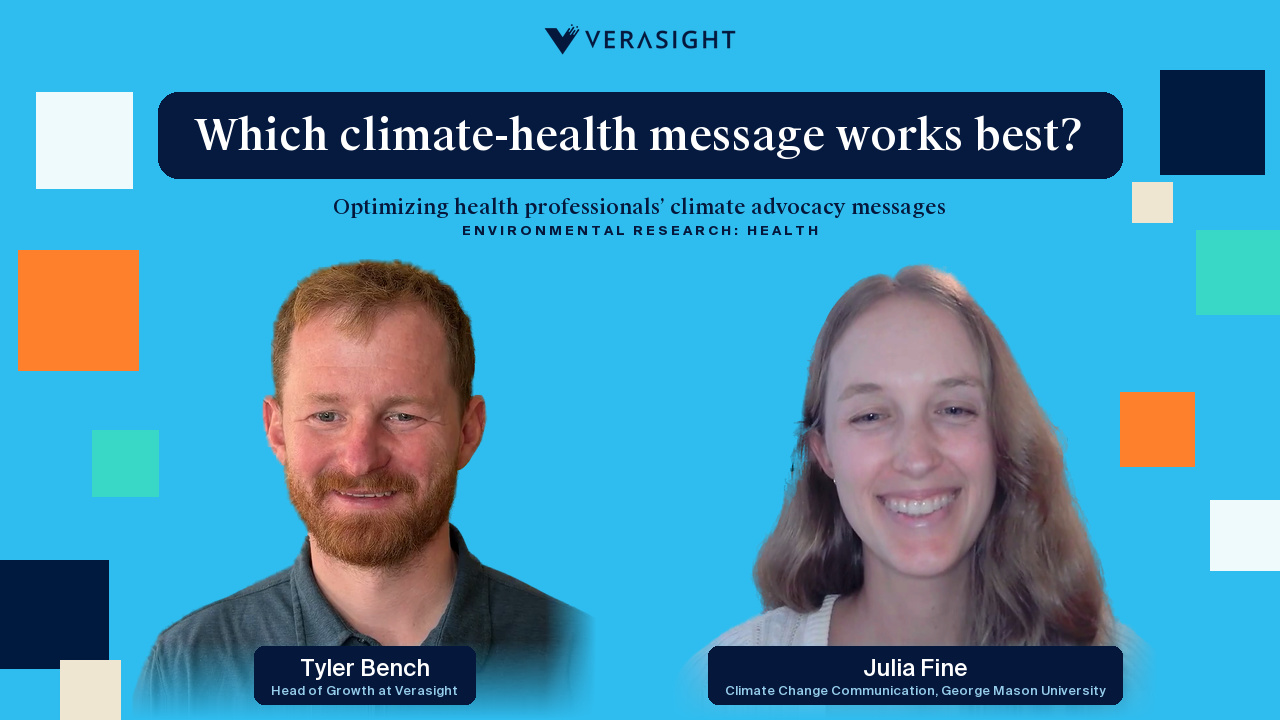
Julia Fine, Research Assistant Professor at the George Mason University Center for Climate Change Communication, joined Verasight to talk about "Optimizing health professionals' climate advocacy messages," her paper with colleagues, published this year in Environmental Research: Health. The study tested how health professionals can frame climate advocacy messages, and its message experiment was fielded by Verasight. In this article, we highlight the key points from the interview and the research team's next steps.
Every message increased trust in health professionals as sources of climate change information
The study showed people one of four versions of a mock news article about health professionals calling for climate action, or no article. Fine pointed to one result that held across all four articles.
"And one really encouraging result that we saw is that all of the messages we tested resulted in a modest increase in trust in health professionals to communicate climate change information. So that's great. It shows that not only are these messages not backfiring, not reducing trust in health professionals as sources of climate change information, but they're actually boosting that."
In a post-hoc comparison with the control group, each of the four articles led to a small increase in trust in health professionals as a source of information about climate change. Two of the articles, "End Fossil Fuels: Delay Means Death" and "Clean Energy Now: Start Saving Lives," also led to a small decrease in support for fossil fuels relative to the control group.
No major differences between message frames
The experiment randomly assigned participants to read one of four versions of a mock news article about health professionals calling for climate action, or to a control group that saw no article. The versions crossed a "do more good" frame ("Clean Energy Now") or a "do less bad" frame ("End Fossil Fuels") with a gain frame ("Start Saving Lives") or a loss frame ("Delay Means Death"). Fine described what the team found.
"Sometimes you do an experiment and you see these really dramatic differences in the conditions and you know exactly how you're going to write your paper. And this is not one of those times. It was more like, well, kind of like crickets or tumbleweed. We really weren't seeing much variation between how the different conditions performed. So that makes for a harder paper to write, but it's also really good news for the people on the ground doing this type of communication, which is there's actually not that much difference between how the conditions performed. So you can kind of go with whatever your strong suit is as a communicator."
The loss frame did not differ from the gain frame on any of the six outcomes the study measured. The "Clean Energy Now" frame increased support for renewable energy compared with the "End Fossil Fuels" frame, but the two did not differ on any other outcome.
Next steps
The interview was recorded on September 16, 2026. Fine described the practical implications of the findings and the team's next steps.
"In terms of practical implications... it's really important that health professionals continue to speak up for climate no matter what message they use, and they do have some latitude in which to select. And then in terms of next steps for our research, it's pretty open still, but we're thinking a lot about data centers and public sentiment around that, as well as continuing to activate trusted messengers, like not just doctors, but also emergency responders."
About the data
The study has two parts. The message experiment was conducted online through Verasight in the fall of 2025 with a nationally representative sample of 1,007 respondents, quota sampled and balanced on gender, age, education, income, Hispanic ethnicity, race and political ideology. Participants were recruited from the Verasight panel, whose members were recruited through address sampling, random SMS sampling and online targeting. The second part was a survey of 806 health professionals in the Medical Society Consortium on Climate and Health, recruited through the consortium's email list. The findings on message effects described in this article, including trust and fossil fuel support, come from the Verasight experiment.