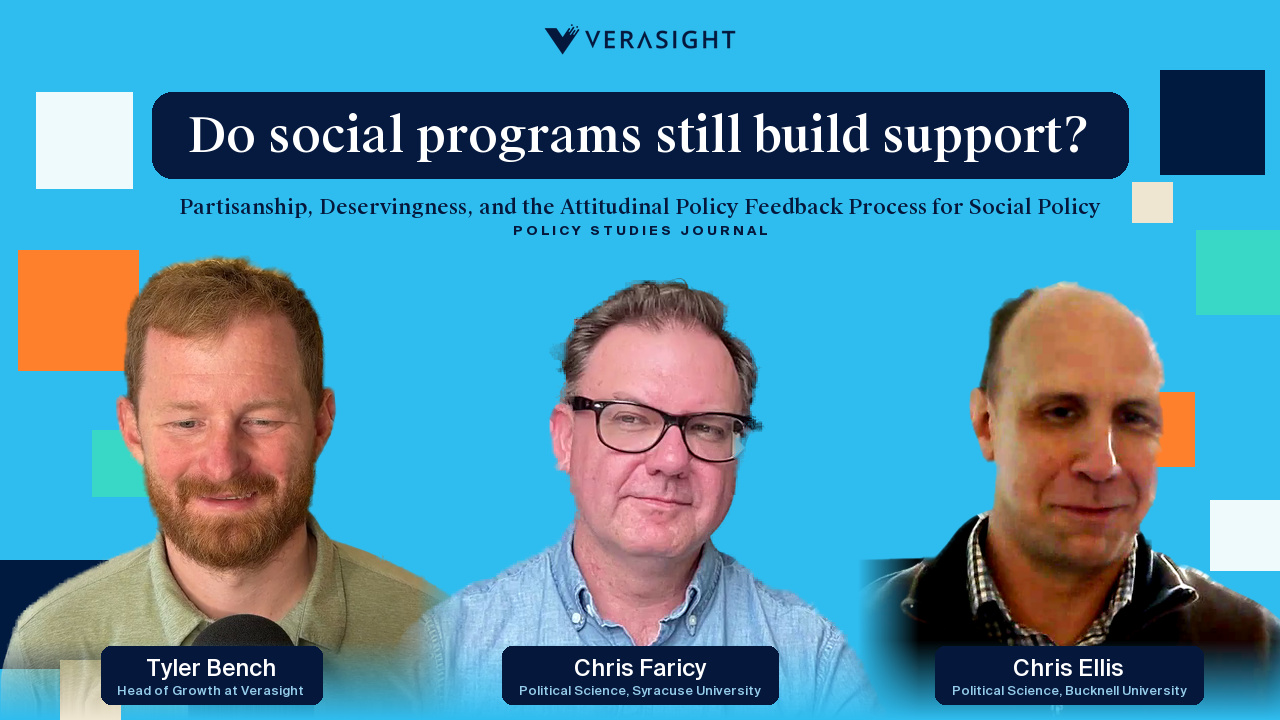
Chris Faricy, Associate Professor of Political Science at Syracuse University, and Chris Ellis, Professor of Political Science at Bucknell University, joined Verasight to talk about "Partisanship, Deservingness, and the Attitudinal Policy Feedback Process for Social Policy," their article in Policy Studies Journal. The article asks whether social programs still build support among the people who use them, and it draws on two nationally representative surveys, including one fielded by Verasight. Below are highlights from the conversation. Watch the full interview on the Verasight YouTube Channel.
Why partisanship can interrupt policy feedback
Policy feedback is the idea that a program, once in place, builds its own base of support among the people who use it. Ellis explained why partisanship can interrupt that process.
"One of the reasons that the policy feedback has sort of worked in creating enduring policies is because once a policy becomes sort of entrenched, it becomes really hard to walk back... What we're sort of showing, among other things, is that the polarization piece kind of throws a monkey wrench into this. That, for example, when a Republican receives aid from a government program, there's a bit of a cognitive dissonance, right? Because on one hand, this program is helping me, but on the other hand, government aid recipients are bad. They're undeserving, they're lazy, they're entitled, whatever. And so you're sort of put in this position where emotionally, for lack of a better term, you feel bad about receiving this assistance, right? You feel shame, you feel maybe some anger."
The article's survey data show the views behind that tension. Asked how well a set of terms describes government aid recipients, 77% of Democrats said "hardworking" describes them very or somewhat well, compared with 40% of Republicans. Among Republicans, 59% said "entitled" and 61% said "ungrateful," compared with 34% and 25% of Democrats.
Republicans more likely to report negative feelings about using Social Security, unemployment and tax credits
To measure how people feel about using social programs, Faricy and Ellis asked respondents to a Verasight survey to pick their immediate feeling about using each of four programs: Social Security, unemployment benefits, a tax subsidy for college and a tax subsidy that supplements wages. The programs were chosen to include ones that are seen as moderate or conservative, not only ones associated with Democrats. Faricy explained how they chose the programs.
"We looked at programs that go to older people like Social Security, and older people are more associated with the Republican Party. We looked at tax credits and tax incentives are either viewed as a kind of a moderate or conservative type of policy. And even looking across those different types of policies, some of which might be moderate or right coded, we still see these partisan differences... Republicans were more likely to report negative emotions than Democrats, even with programs such as Social Security that you might think people would be more positive about."
For Social Security and unemployment benefits, most respondents in both parties chose a positive emotion such as gratitude, relief or satisfaction. The partisan gap appeared in every program. The article's model estimates that Democrats had a 0.71 probability of choosing a positive emotion about using Social Security, compared with 0.56 for Republicans. The largest gap was for the college tax credit, at 0.65 for Democrats and 0.37 for Republicans.
The "who" of policy
Faricy described the larger argument behind their work about how people judge policies.
"There's a fundamental question about what politics is, and it's the study of who gets what, when, where, and how. And a lot of people study about public opinion towards policies has been on the what or the how, but has neglected the who, right? And what we're arguing is that the who gets policy is as much or more of a factor in how people formulate support or opposition to a whole range of policies than the what and the how."
The article's favorability ratings show the pattern on a 0 to 10 scale. Democrats rated government aid recipients 7.03 and taxpayers 7.56. Republicans rated taxpayers 7.97 but aid recipients 4.82. The partisan gap in ratings of aid recipients, 2.21 points, was much larger than the 0.41-point gap in ratings of taxpayers.
Next steps
The interview was recorded on August 24, 2026. Ellis said the article is building toward a forthcoming book that draws on data from about seven Verasight surveys and looks at what the polarized era means for how citizens make sense of social policy.
"What people are thinking about now is like, who's getting the benefits, right? Is this benefiting people that I personally like and identify with or not?"
About the data
The article draws on two nationally representative surveys. One was conducted by Verasight from July 31 to August 7, 2023, with 1,100 adults, for the Campbell Public Affairs Institute at Syracuse University. The other was conducted by YouGov for the Bucknell Institute for Public Policy. The findings on how people feel about using social programs come from the Verasight survey.