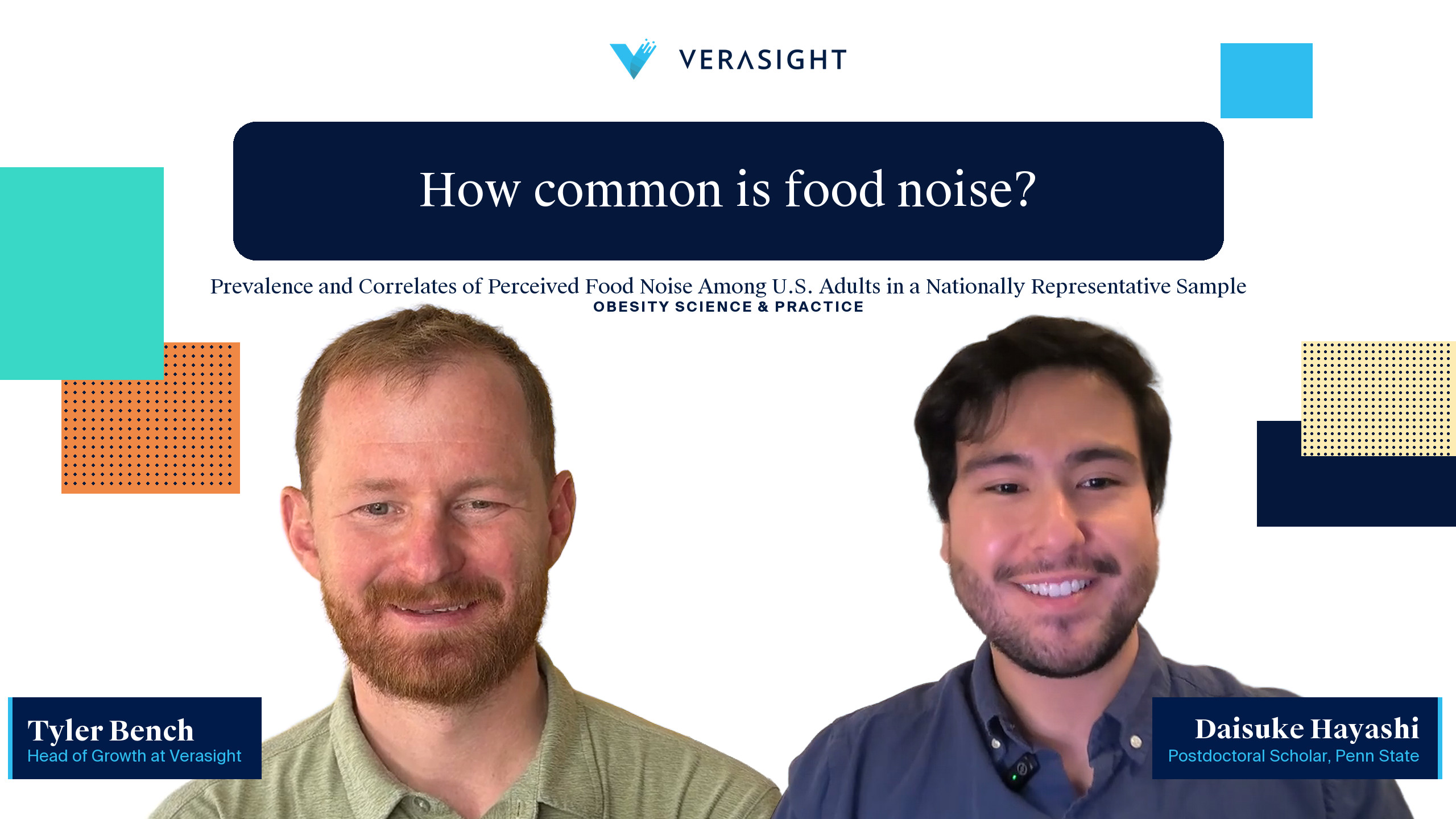
Daisuke Hayashi, a postdoctoral scholar in the Health, Ingestive Behavior, and Technology (HIT) Lab at Penn State, joined Verasight to talk about "Prevalence and Correlates of Perceived Food Noise Among U.S. Adults in a Nationally Representative Sample," a new paper with Travis D. Masterson in Obesity Science & Practice. Data were drawn from Verasight's SBM Omnibus Survey (May 2026; N = 1000). In this article, we highlight the key points from the interview and discuss next steps for this area of research.
Food noise does not yet have an agreed scientific definition
"The three words you will not hear from me are: food noise is. Because it's something that scientists are actually trying to understand. We have a lot of hypotheses, and different research groups have different ways of looking at it. But generally speaking, the way people have been describing it in the media and in conversations between patients and clinicians is something related to having thoughts about food that take up a lot of space in your mind that are too frequent."
Rather than score how severe food noise is, the study set out to estimate how many adults identify with the experience as it is described in the media and on social media. A single question asked how often respondents experience it: "'Food Noise' is a term popularized in media and social media to describe things like 'constantly thinking about food, even when not hungry,' or feeling like one's life revolves around food. How often do you experience 'Food Noise'?" Answers ran from 1 (Never) to 5 (Always), and the authors grouped often and always as frequent food noise. The paper describes this as a measure of self-reported experience, not a clinically validated one, and notes that scales such as the Food Noise Questionnaire (FNQ) and the RAID-FN were built to quantify severity in clinical populations.
More than half of U.S. adults report experiencing food noise
"I think the first one, and the most impressive, is how common it is. More than half of US adults reported experiencing food noise, loosely described as feeling like you have food on your mind all the time, or you feel like your life revolves around food because of how much you think about it. One in two US adults reporting they feel it at least sometimes, and almost one in five reporting they feel it often or always. This was something we did not expect to be that common."
Figure 1 of the paper shows the weighted answers for the full sample of 1,000 adults. In all, 50.89% reported experiencing food noise at least sometimes: 32.91% sometimes, 11.87% often and 6.11% always. Another 32.07% said rarely, and 17.03% said never. The share reporting frequent food noise, often or always, was 17.98%.
Frequent food noise was more common among women than men (22.70% vs 12.68%) and among younger adults, from 26.50% of adults aged 18 to 29 down to 13.49% of those aged 60 and older. It was also reported by 25.76% of current GLP-1 medication users and 26.78% of former users, compared with 16.30% of non-users. The authors note that this pattern may seem counterintuitive at first, given reports that these medications might reduce food noise. They write that it is "likely explained by selection rather than treatment effect": people living with obesity or insulin resistance, conditions associated with heightened food cue reactivity, are the ones most likely to seek or be prescribed GLP-1 medications.
Loss of control over eating and frequent food noise
"The big overlap between reporting frequent food noise and other maladaptive patterns related to food, like people who reported losing control over what they eat... They were five times more likely to report experiencing frequent food noise. And people who experience frequent food noise, they also were more likely to rate the quality of their diet as lower, their mental health as lower. It really seems to be something that overlaps with a lot of mental and behavioral burden, and all of these things should be investigated in future studies."
Among respondents who reported loss of control over eating in the past month, 56.77% reported frequent food noise, compared with 17.98% of the full sample. In the paper's multivariable model of 938 complete cases, loss of control over eating was the strongest independent predictor of frequent food noise, with an odds ratio of 5.95 (95% CI: 4.05 to 8.75). Asian non-Hispanic race or ethnicity (odds ratio 2.19), current GLP-1 use (1.60), eating less to change weight or shape (1.57) and self-identifying as female (1.47) were also independently associated with it.
Respondents with frequent food noise also rated eating quality lower (a mean of 2.91 vs 3.30 on a five-point scale) and mental health lower (2.98 vs 3.49) than those with infrequent food noise. The paper describes these associations as hypothesis-generating: the data come from a single point in time and cannot show what causes what.
Next steps
Asked what comes next, Daisuke Hayashi described work under way in the HIT Lab: a qualitative study following how experiences of food noise change over time among people who report it, and longitudinal projects with people taking GLP-1 receptor agonists to see how those medications change cognitions around food. The paper points the same way. It calls for longitudinal designs with assessments before and after treatment to tell baseline vulnerability apart from changes linked to the medications, and it concludes with "the need for further research to define, measure, and understand its clinical significance."
About the data
Data were drawn from the Society of Behavioral Medicine (SBM) Omnibus Survey, an online survey of 1,000 U.S. adults administered by Verasight in May 2026. The paper is a secondary analysis of that cross-sectional dataset, which also asked about GLP-1 medication use, weight and eating behaviors, diet quality, social support, health and demographics. Percentages are weighted to match the U.S. adult population by age, sex, race and ethnicity, income, education, region, metropolitan status, partisanship and 2024 presidential vote. In the sample, 12.40% reported current GLP-1 use (n = 124), 5.30% former use (n = 53), and 82.30% no use in the past 12 months (n = 823). The paper's funding statement reads: "Access to the database was provided free of cost by Verasight to attendees of the 2026 meeting of the Society of Behavioral Medicine (SBM)." The authors list the cross-sectional design, the use of single items, and respondents' own reading of terms such as loss of control over eating among the study's limitations.