Survey research rests on a few basic assumptions: that respondents are real people, that they offer sincere responses, and that they collectively represent the population being studied. How a survey provider verifies those things, without distorting the sample in the process, is one of the defining questions for modern survey research.
Verasight has developed end-to-end verification technology to accomplish these goals, and two recent independent studies show the technology is working.
Across the industry, verification practices vary widely. Some providers require every respondent to upload a picture and a valid government ID before ever taking a survey. Others rely exclusively on in-survey fraud indicators, such as device fingerprinting, behavioral analysis, and duplicate detection. Still others access survey data from marketplaces that aggregate responses from an opaque network of vendors, trying to address data quality issues after data collection.
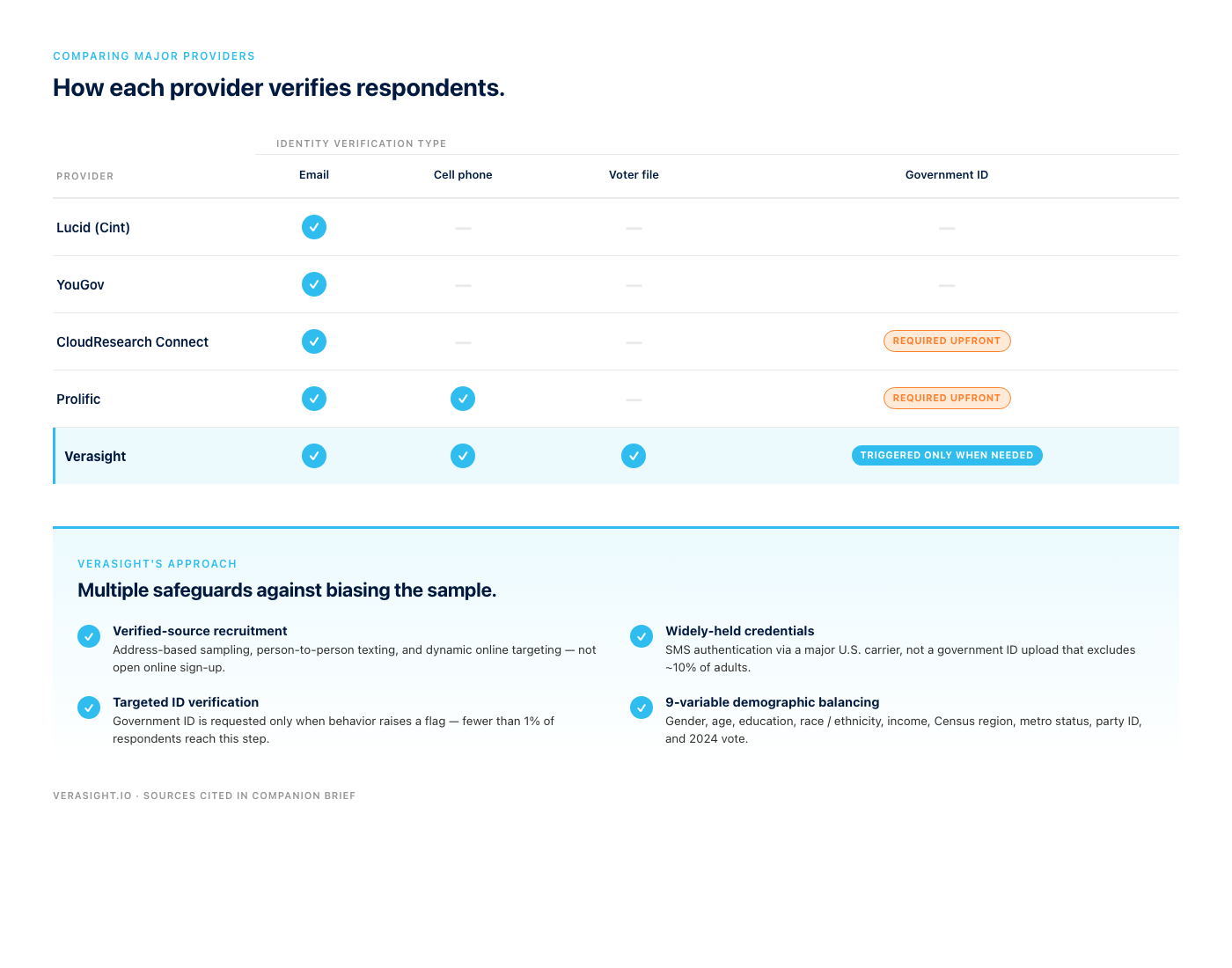
Each of these approaches addresses part of the problem and leaves part unsolved. Requiring an upfront government ID introduces sample bias by filtering out everyone unwilling to upload their picture and ID. Relying only on within-survey fraud detection catches duplicates and bots but does not confirm who individual respondents actually are.
Verasight takes a more holistic approach. We verify respondents across the entire survey lifecycle — before a survey, during a survey, and after a survey — rather than at any single point. Two principles guide this approach. First, it should be thorough, with checks layered across the journey. Second, it should avoid introducing bias into the sample.
Why one verification step isn't enough
Pre-survey verification
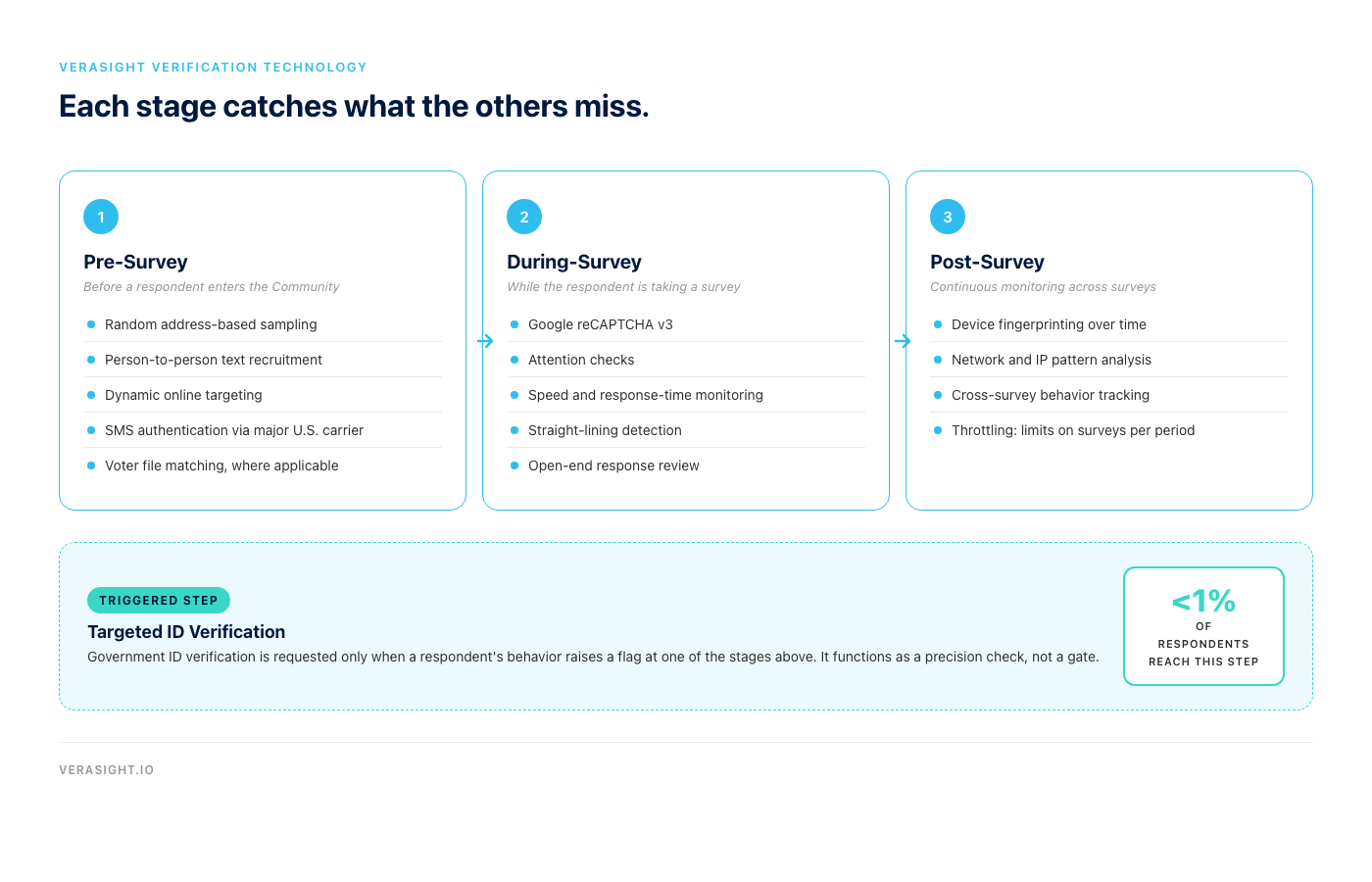
Verasight Community members are recruited through three controlled channels: random address-based sampling, random person-to-person text messaging, and dynamic online targeting. For address-based sampling, we confirm that the respondent matches the individual selected from the verified list. Every Community member then completes SMS authentication through a mobile phone registered with a major U.S. carrier — the same approach banks use to verify account access. VOIP and internet-only phones are not accepted. Where applicable, we match respondents against voter file records.
During-survey verification
Inside every survey, Verasight runs continuous quality checks: Google reCAPTCHA v3 to identify non-human responses, attention checks, response-time monitoring to catch speeding, and straight-lining detection. Open-ended responses are reviewed for coherent, on-topic content.
Post-survey verification
Quality monitoring continues across surveys over time. Verasight tracks device fingerprints, network behavior, and response patterns across every survey a Community member takes. Respondents who repeatedly speed, straight-line, or show inconsistent answer patterns are flagged, reviewed, and removed from the Community. Members are also throttled (limited in how many surveys they can take in a given period) to mitigate respondent fatigue.
Targeted ID verification
Verasight uses government ID verification as a precision tool, triggered only when a respondent's behavior raises a quality flag (for example, when multiple accounts appear to operate from the same device or IP address). This step gives sincere respondents who inadvertently triggered a quality flag a path back into the panel. This step verifies and reinforces other fraud checks without applying a sample-distorting filter to the broader population. Fewer than 1% of respondents reach this step in practice; it functions as a precision check, not a gate.
Why this approach captures more of the population
A verification method is only useful if the resulting sample still represents the population. Two design choices set Verasight apart on this front.
First, recruitment and authentication rely on widely-held credentials. A working U.S. mobile number is held across virtually every demographic group; a current government ID is not. Roughly 10% of U.S. adults do not have a current driver's license, and that 10% without ID is concentrated among younger adults, lower-income households, Black and Hispanic Americans, and individuals with disabilities. Requiring an uploaded ID at the door excludes those groups. SMS authentication through a major U.S. carrier does not. The downstream effect of an upfront ID requirement is that the resulting sample skews toward respondents who routinely upload IDs for income. In other words, the resulting sample skews toward professional survey-takers.
Second, Verasight balances samples on a wider set of demographic variables than is standard in the industry. Verasight's nationally-representative samples are weighted on gender, age, education, race/ethnicity, income, Census region, metropolitan status, party identification, and 2024 vote — nine variables in all. The result is a sample that looks like the U.S. adult population.
These design choices show up in observable survey behavior. Roughly 30% of Verasight respondents take surveys on desktop computers. In contrast, Prolific (which requires an upfront government ID upload) has reported a desktop share well above the population baseline. Heavy desktop usage is a marker of professional survey-takers, who introduce their own biases: they learn to pass attention checks, rely on surveys as a source of income, and carry topics from one survey into their responses on the next.
Validation from independent research
Two independent research studies have examined Verasight data and confirmed this layered approach works as intended. The first, funded by Prolific and co-authored by seven researchers including David Rothschild of Microsoft Research, used automated environment checks plus six behavioral tests to identify AI agents in actual surveys. Across both measures, the study found near-zero evidence of AI agents in Verasight data. A second independent study reached equivalent results, prompting Dartmouth Professor Brendan Nyhan to comment that "the sky is not falling."
Verifying that respondents are human is necessary for survey research, but it is not sufficient. A representative sample is what allows survey results to describe the population, which is why Verasight's verification is designed not just to keep bots out, but to keep representative respondents in.