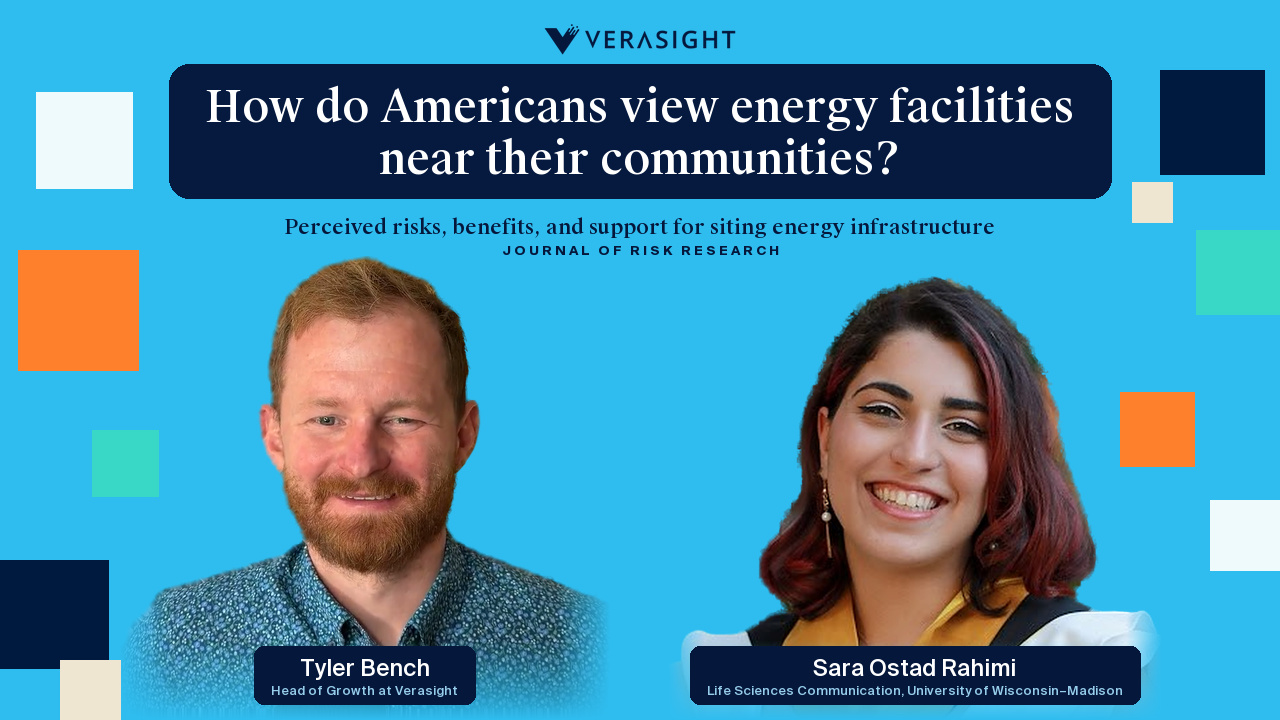
Sara Ostad Rahimi, PhD Candidate in Science Communication in the Department of Life Sciences Communication at the University of Wisconsin-Madison, joined Verasight to talk about "Perceived risks, benefits, and support for siting energy infrastructure: comparing perceptions of carbon capture, nuclear fuel, and large-scale energy facilities," her paper with colleagues, published this year in the Journal of Risk Research. The study used a nationally representative survey experiment fielded on the Verasight panel to compare how Americans view three kinds of energy facilities when they imagine one being built near their community: a used nuclear fuel storage facility, a carbon capture and storage facility, and a generic large-scale energy facility. In this article, we highlight the key points from the interview and the research team's next steps.
Fewer perceived benefits of used nuclear fuel storage
Participants were divided into three groups, each asked about one type of facility. Along with closed-ended questions, the survey asked them to describe, in a sentence or two, the challenges and benefits they saw. Ostad Rahimi said the answers about benefits differed by facility type.
"When we asked them to describe the benefits of carbon capture facility, for example, a lot of benefits to the environment. And when we asked them to describe the benefits of a large scale energy facility, a lot of benefits to economic growth in the region that they might get sited. But when it came to nuclear fuel storage, what was really fascinating was the second ranked option, meaning the second most amount of people talked about this, was they just said nothing. When we asked them what the benefit is, they said nothing. 'I don't think there is a benefit to this facility,' which is really important for people who are invested in siting these kinds of facilities in communities."
The paper reports that used nuclear fuel storage facilities were perceived as significantly riskier and less beneficial than carbon capture or generic large-scale energy facilities. The abstract also reports that the benefits people named for used nuclear fuel storage were tied to economic utility. Ostad Rahimi said the risks people described for used nuclear fuel storage were more specific, such as radiation and cancer, while the risks they described for the generic facility were less defined.
Support was higher for a closer facility
The study also asked how much participants would support a facility at different distances from their community. Ostad Rahimi described a result that may seem counterintuitive.
"When we asked participants how much they would support a nuclear waste facility that was 10 miles away from them, they actually had higher support than when we asked them how much they would support it if it was 50 miles. And their support would drop, which might feel a little counterintuitive. They're like, oh, if it's farther away, it's less harm to you. Why would you support it less? And one of the reasonings might be because if it's closer, the community feels like they have some sort of control over it. They have city council members that they can go to complain about it. They can attend meetings to really let their frustrations be known versus if it's 50 miles away, they're really removed from where it's going to be. Even if they don't like it being 50 miles away, they can't really influence those decisions because the people making those decisions and their policymakers and the people that they have voted for are here, not 50 miles away."
The paper finds that support increases with proximity, but that proximity does not override the differences in how people perceive each type of technology.
How mental models may shape views of a facility
Ostad Rahimi said people working to site these facilities in specific communities should be aware of how the risks and benefits of each facility are perceived, and described a concept from the paper.
"In this paper, we talk about something called a mental model. It's just little shortcuts that everyone uses on daily. That's just kind of in their head. It's a little tiny model of how the world works and we just use it to make quick decisions. So a lot of people, when it comes to anything that has to do with nuclear energy, have this mental model of nuclear disaster, which is fair. It has been built upon a lot of experience from existing accidents, tragic accidents, media coverage. If a lot of people have this mental model, it would not be a best approach to ignore that and just kind of walk into a community and pretend as if those mental models are just wrong or that the community is wrong and just try to continue to just go full speed ahead and try to site this facility, even though these risks and these concerns exist within the community."
The paper's abstract says the findings illustrate the importance of tailoring public engagement and communication strategies to distinct facility types and community mental models.
Next steps
The interview was recorded on September 23, 2026. Ostad Rahimi said the team extended this research with focus groups of people from urban, suburban and rural communities, each focused on one of the three facility types, which asked about risks and about co-design, where the public and scientists work together on how a facility is sited and managed. The team is preparing a manuscript on those results. Her own research also covers public and expert perceptions of fusion energy and, in her dissertation, disabled people's perceptions of emerging science and technologies.
About the data
The study is a nationally representative survey experiment of 1,141 U.S. residents, fielded on the Verasight panel. Participants were assigned to consider a used nuclear fuel storage facility, a carbon capture and storage facility, or a generic large-scale energy facility, which served as the control. The survey combined closed-ended questions with open-ended responses, which the authors analyzed using structural topic modeling (STM). All of the study findings described in this article come from this Verasight survey. The focus groups described under Next steps are separate work.