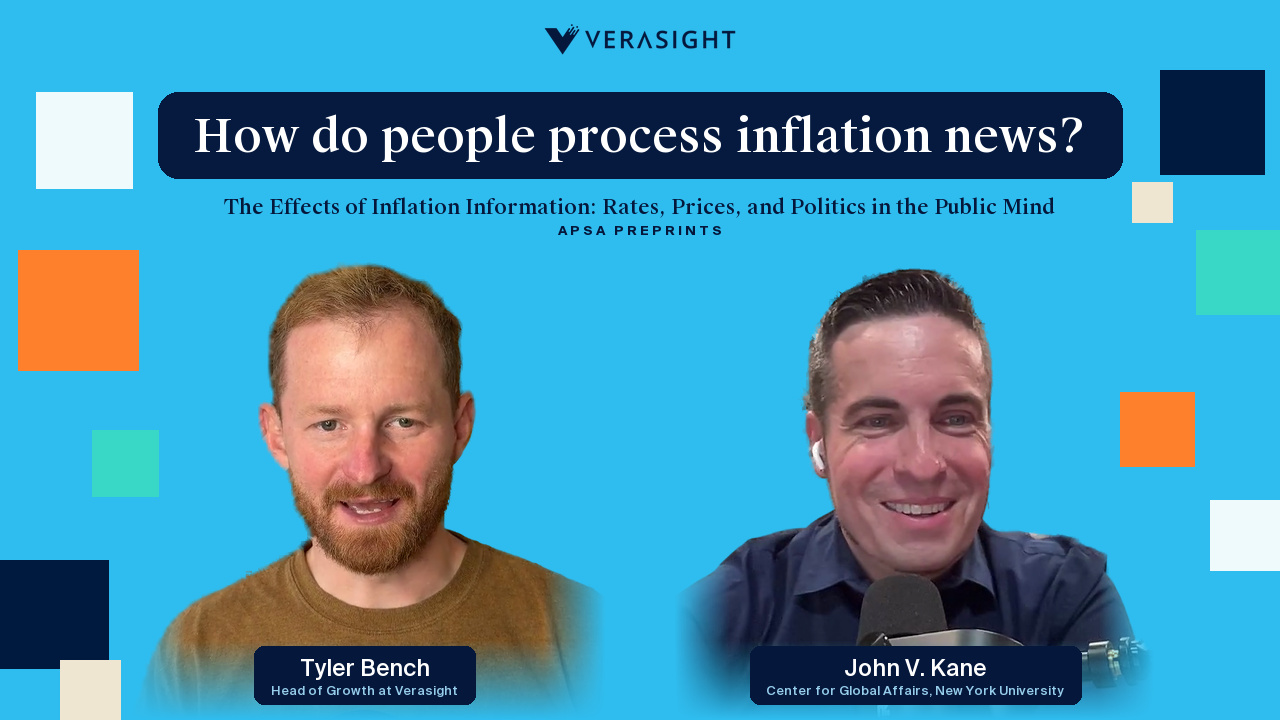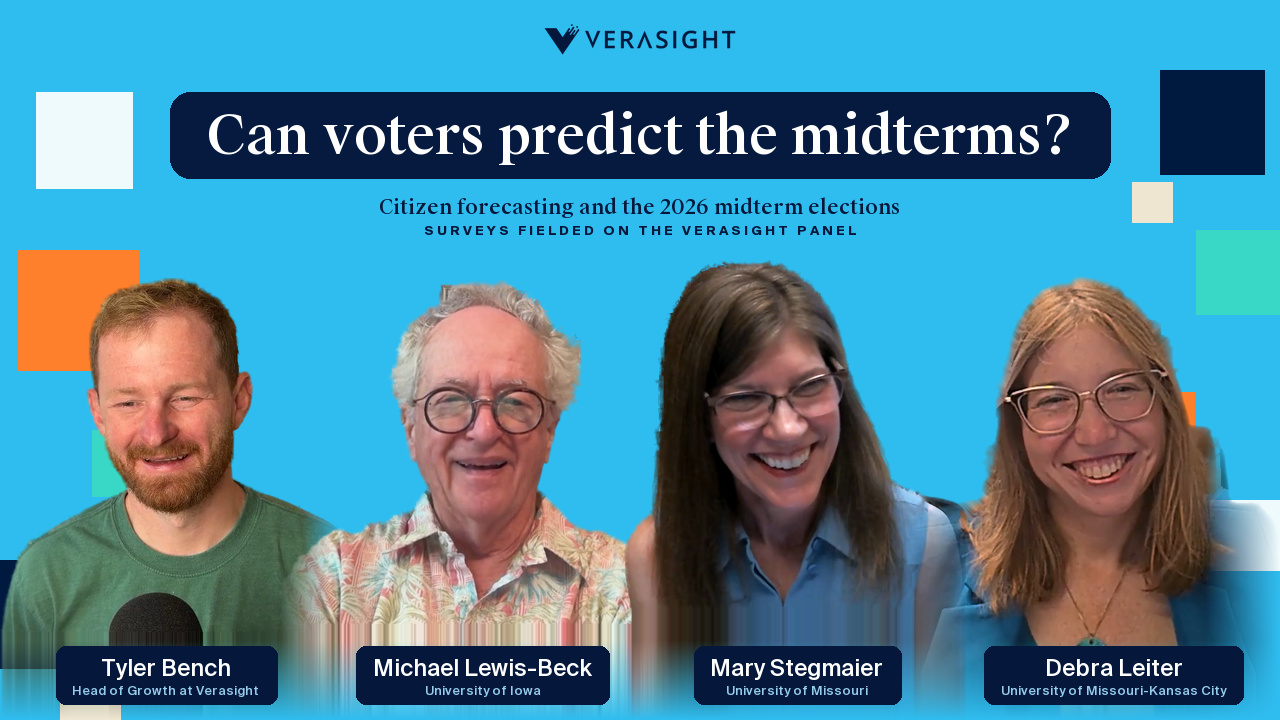
Michael Lewis-Beck, F. Wendell Miller Distinguished Professor of Political Science at the University of Iowa; Mary Stegmaier, Vice Provost for International Programs and Professor of Government and Public Affairs at the University of Missouri; and Debra Leiter, Associate Professor of Political Science at the University of Missouri-Kansas City, joined Verasight to talk about citizen forecasting, which asks people who they expect to win an election rather than how they plan to vote. Their forecasts of the 2026 midterm elections use surveys fielded on the Verasight panel, including their most recent article in Sabato's Crystal Ball, "Rust on the Midterm Iron Law? Voter Expectations for 2026." In this article, we highlight the key points from the interview and discuss next steps for this area of research.
Asking voters who will win, not how they will vote
Lewis-Beck explained where the idea started.
"Back in the late 1980s, Andrew Skalaban, who was a grad student in Iowa, and I started thinking about citizen forecasting. And that means, simply put... what do voters think about who will win? Not how are they going to vote, but who will win... We looked at the American National Election Study, which is the gold standard public opinion data source, which happens to have asked, who do you think will win in November with regard to the presidential election? And they've asked that basically since 1952, every election. So what we showed in that paper was that, in fact... citizens were quite good at forecasting, even if they forecasted Republican when they were Democrats or vice versa."
A vote intention poll asks people whom they plan to vote for. A citizen forecast asks who they think will win. Lewis-Beck and Andrew Skalaban's 1989 paper in the British Journal of Political Science, "Citizen Forecasting: Can Voters See into the Future?," used the American National Election Studies question on who respondents expected to win the presidential race. Lewis-Beck notes that citizens forecast well even when they expected a win for the party they did not identify with.
Citizens adjust when models cannot
Leiter described how voters update their expectations, then returned to the point after Lewis-Beck and Stegmaier weighed in.
"It's not just an estimation that, OK, we know at midterms, incumbent party loses seats. Voters are responding to micro and macro changes in the political realm in a really interesting way... This is one of the great and exciting things about citizen forecasting: long-term structural models have a hard time adjusting to things like a surprise mid-decade redistricting. But citizens don't. They are able to respond to those things in a very exciting way. And so that's one of the things that's really great about having these multiple waves of surveys, is that we can test these things and actually show voters responding and changing our forecast in a dynamic way."
The pattern Leiter describes, which their Crystal Ball article calls the midterm "iron law," is that the president's party loses seats in a midterm election. Structural models build in regularities like that one, so they move slowly when something new happens. Repeated surveys can pick up the change. In their November 2025 Crystal Ball article, the team compared two Verasight surveys. In April 2025, 58% of respondents expected Republicans to win the House and 42% expected Democrats to. By September 2025, 51% expected a Republican House and 43% a Democratic one, cutting the Republican lead in expectations from 16 points to 8. In the interview, Leiter said the team now has four waves running from September 2025 through May 2026, and that expectations for the Democrats were highest in March. Stegmaier added that there was a lot of news about mid-decade redistricting when the May survey was in the field, which some respondents may have taken into account.
Citizens are smart
Near the end of the interview, Stegmaier described what the approach says about voters.
"Sometimes citizens are dismissed for not knowing much about politics, not understanding the political system or paying attention. But ultimately, what we see and what this approach relies on is that citizens are knowledgeable, that they pay attention. They might not be reading every single news article or all the polls or memorizing economic data or approval polls, but they understand politics and they understand their experiences. So part of this is also a message that Americans and citizens in other countries are smart. They're capable of making a forecast that is beyond just how they intend to vote."
Murr, Stegmaier and Lewis-Beck's 2021 paper in the British Journal of Political Science, "Vote Expectations Versus Vote Intentions: Rival Forecasting Strategies," compared eight forecasting models for British general elections using polls from 1950 to 2017. One model was built on voters' expectations of who would win and seven on vote intentions. The authors found that vote expectation models outperform vote intention models at predicting both the winning party and each party's share of seats.
Next steps
The interview was recorded on September 8, 2026. Asked what to expect as the election gets closer, Leiter pointed to the team's next survey wave.
"We do see races tightening up. We'll have by the end of this point pretty much all the primaries settled... I suspect that by the end of this survey period, we're going to have a much better sense of what voters really think is going to happen in November... What they tell us, I think, is going to be a great preview for November, especially with those increasingly competitive races for the Senate."
Stegmaier added that the team's questions were going into Verasight's September 2026 survey.
"We're excited to have the survey, the battery of questions that we have been asking as a team over the past year and a half... in the upcoming Verasight survey that will go to the field later this month."
Leiter also pointed readers to a special issue on forecasting in PS: Political Science & Politics, which she expected in October, featuring many different kinds of forecasts from political scientists and economists.